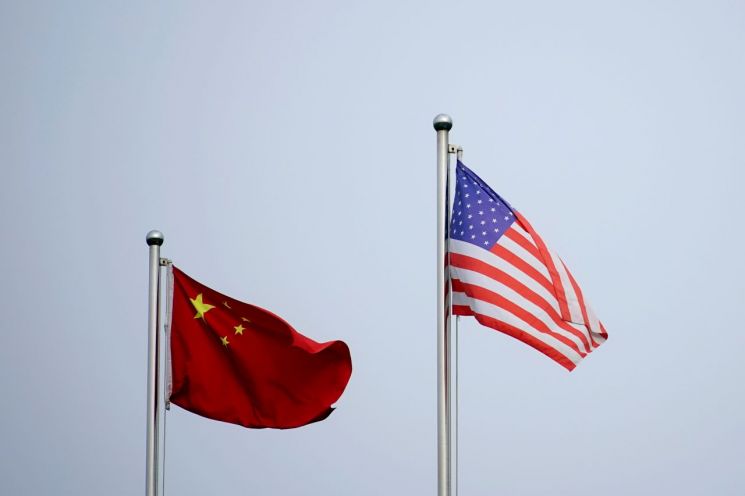
[Asia Economy Reporter Jeong Hyunjin] It has been revealed that the United States is preparing a 'China Containment Package Act' to gain a favorable position in the long-term competition with China. Accordingly, there are claims that domestic companies trading items that could potentially be involved in sensitive issues with China should closely monitor the situation.
The Korea International Trade Association's International Trade and Commerce Research Institute reported on the 23rd in its report titled 'Key Contents and Implications of the US China Containment Package Act, the United States Innovation and Competition Act (USICA)' that the recently passed US Senate 'United States Innovation and Competition Act' comprehensively covers expanding the science and technology base, actively utilizing sanctions against China, reducing the burden on US importers due to US-China trade disputes, and preventing capital outflow to China. This bill, spanning over 2,300 pages, is expected to be formally enacted as law within the year after negotiations between the Senate and House and the President's signature.
The bill consists of seven detailed acts aimed at achieving two goals: 'maintaining the science and technology gap with China' and 'preparing for the prolonged US-China trade dispute.' Among the detailed acts, the 'Endless Frontier Act' includes provisions to expand the science and technology support budget and strengthen STEM education to maintain the science and technology gap with China. The 'America COMPETES Act' mandates the purchase of American-made steel and construction materials in infrastructure construction and procurement markets within the US to boost the economy and strengthen the position of American industries after COVID-19.
The 'China Challenge Response Act' and the 'Strategic Competition Act' contain more explicit measures to contain China. They include provisions to more actively sanction China for actions contrary to American values such as human rights abuses and to prevent US funds from flowing into Chinese state-owned enterprises, the government, or the People's Liberation Army through Chinese companies operating in the US.
In particular, to enhance the effectiveness of sanctions, the necessity of joint export controls and import bans on China with allied countries is also mentioned. The 'Trade Act of 2021' includes provisions to continue the exemption system for additional tariffs on China and other tariff reductions for US importers and consumers affected by trade disputes with China.
The report pointed out that the Biden administration assumes continued US-China conflicts and that the US may propose joint export-import controls on China to South Korea based on this law in the future. It also recommended that Korean companies operating in the US check whether the Chinese government or Chinese companies subject to sanctions are directly or indirectly included in their product production supply chains.
Lee Wonseok, a research fellow at the Korea International Trade Association, said, "Looking at provisions such as tariff reductions included in this law, it can be seen that the US also assumes a prolonged US-China trade dispute and intends to minimize domestic side effects." He added, "Our companies trading items that could potentially be involved in sensitive issues such as intellectual property theft or human rights abuses with China should continuously monitor the legislative trends of this bill."
© The Asia Business Daily(www.asiae.co.kr). All rights reserved.

















