Tenants Angry at Government Boasting Only About Lease Renewal Rate
Jeonse Prices Soar, Landlord-Tenant Conflicts Intensify
Renewal Contract Holders Also Say "Worrying More About Next Contract"

[Asia Economy Reporter Lim On-yu] "A year ago, the jeonse price has now become a half-jeonse price. Most of my salary goes to loan interest and monthly rent, so how can this be called housing stability?"
The statement by Deputy Prime Minister and Minister of Economy and Finance Hong Nam-ki about ‘market stabilization’ following the implementation of the new Lease Protection Act is causing an unexpected backlash. Tenants who have experienced an unprecedented jeonse crisis are growing increasingly angry. Critics argue that the government’s self-serving interpretation ignores various side effects such as the surge in jeonse prices, increased disputes between landlords and tenants, and the conversion of jeonse to monthly rent.
According to the real estate industry on the 22nd, after Deputy Prime Minister Hong announced the achievements of the new lease law, including the right to request contract renewal and the cap on jeonse and monthly rent implemented at the end of July last year, various real estate communities erupted with complaints. Despite the severe jeonse crisis since the law’s implementation, Hong promoted the policy by stating that "the majority have benefited from the system." He cited the increased lease contract renewal rate as evidence, noting that the renewal rate for apartment leases in Seoul rose about 20 percentage points from 57.2% to 77.7%.
However, Hong’s remarks are facing criticism for deliberately ignoring tenants who experienced a surge in jeonse prices during new contracts. According to KB Real Estate’s monthly housing price trends, the average jeonse price for apartments in Seoul rose from 499.92 million KRW in July last year to 626.78 million KRW in June this year, an increase of 126.86 million KRW in less than a year.
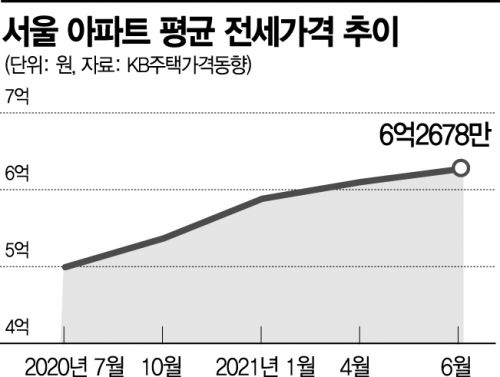
Comparing actual transaction prices from July last year to this year, the perceived surge in jeonse prices is even more pronounced. For example, an 84㎡ unit at Mapo Raemian Prugio in Ahyeon-dong, Mapo-gu, rose from 850 million KRW to 1.17 billion KRW in May, an increase of 320 million KRW. An 84㎡ unit at Raemian Oksu Riverzen in Seongdong-gu increased from 920 million KRW to 1.2 billion KRW last month, up 280 million KRW. In Daechi-dong, Gangnam-gu, an 84㎡ unit at Raemian Daechi Palace rose from 1.6 billion KRW to 2.1 billion KRW in January.
A resident of Seongdong-gu, Mr. A, said, "The jeonse price of the apartment I had my eye on for my wedding next year rose from 400 million KRW to 600 million KRW. I was scared it would rise further in the second half of the year, so I had no choice but to sign the contract early." He added, "It’s a harsh reality that I don’t even have enough money to find a house due to the rapid rise in jeonse prices. What good is it to pour out childbirth promotion policies?" expressing his frustration.
Even tenants who signed renewal contracts, whom the government claims have ‘benefited,’ share strong opposition to the three lease laws. They had no choice but to renew because the jeonse prices rose too much, restricting their housing freedom, and it is obvious that the jeonse price will rise sharply in the next contract. Landlords, who were restricted by the 5% cap under the jeonse and monthly rent ceiling, are likely to raise jeonse prices in the next contract as compensation. This is predictable given the current serious dual pricing phenomenon in jeonse. Mr. B, a tenant in Gangnam-gu who used the right to request contract renewal once last year, said, "The landlord can’t raise the rent for the next four years, so they are just waiting to raise the jeonse price once the contract ends. The contract expiration date feels like a time bomb."
Professor Kwon Dae-jung of Myongji University’s Department of Real Estate said, "Both tenants and landlords are going through a painful time due to the shortage of jeonse and soaring rents, but the government’s self-praise is excessive," adding, "The law should be reviewed for amendments even now."
© The Asia Business Daily(www.asiae.co.kr). All rights reserved.

![A Woman with 50 Million Won Debt Clutches a Stolen Dior Bag and Jumps... A Monster Is Born [Slate]](https://cwcontent.asiae.co.kr/asiaresize/183/2026021902243444107_1771435474.jpg)
















