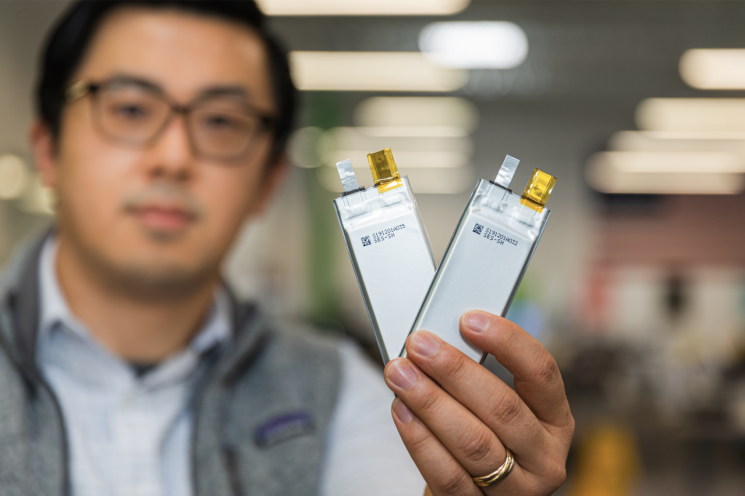
[Asia Economy Reporter Choi Dae-yeol] Chi Chao Hu, CEO of SES (Solid Energy Systems), which is developing lithium metal batteries, one of the next-generation batteries, announced that electric vehicles equipped with their batteries could be released within 4 to 5 years at the earliest.
At an online briefing held on the 21st, CEO Chi Chao Hu said, "We are developing samples of (lithium metal batteries) for electric vehicles and expect to be able to install them around 2025," adding, "Our development speed is about 18 months to 2 years ahead of competitors."
SES, which started as a U.S. startup in 2012, has been recognized for its technology by attracting investments from global automakers such as General Motors (GM) and Hyundai Motor, as well as SK, LG, China's Geely, and Singapore's Temasek. The company is headquartered in Singapore and has pilot production facilities and research centers in the U.S. and China.
Batteries are a key component that determines the performance and price of electric vehicles, and most currently use lithium-ion batteries. Development is underway by increasing lithium content or replacing expensive existing materials, but attempts to develop batteries in different ways, like SES, are also ongoing. The company calls its battery a ‘hybrid lithium metal’ because it can realize both the mass production advantages of conventional lithium-ion batteries and the high energy density advantages of all-solid-state batteries.
One of the main features of the battery material under development is the use of metal instead of graphite for the anode, increasing density. The company explains that this compensates for the low energy density drawback of lithium-ion batteries while being easier to mass-produce compared to all-solid-state batteries. SES is accelerating development together with automakers expanding electric vehicles recently, such as GM and Hyundai Motor, who are major investors and will receive early-stage prototypes.
The battery to be developed in the future is expected to increase driving range by more than 30-40% compared to lithium-ion batteries of the same capacity. If the driving range is kept similar, the battery volume can be significantly reduced. CEO Chi Chao Hu explained, "If an electric vehicle with a conventional lithium-ion battery can drive about 350 miles, an electric vehicle with a lithium metal battery of the same volume or weight can drive over 500 miles."
He also added that the battery SES is developing features fast charging capability that charges up to 80% within 15 minutes, and AI technology that continuously monitors battery status regardless of ignition to enhance safety. Although the exact location for the battery factory under development has not yet been decided, it will be determined based on accessibility to automakers in the future. Asia, including South Korea, is also a candidate. CEO Chi Chao Hu emphasized, "We are still the only ones officially recognized for performance through external testing organizations."
© The Asia Business Daily(www.asiae.co.kr). All rights reserved.
![Clutching a Stolen Dior Bag, Saying "I Hate Being Poor but Real"... The Grotesque Con of a "Human Knockoff" [Slate]](https://cwcontent.asiae.co.kr/asiaresize/183/2026021902243444107_1771435474.jpg)
















