[Asia Economy Reporter Jeong Hyunjin] An evaluation has emerged that the New Southern Policy, one of the Moon Jae-in administration's national tasks, failed to achieve its goals last year. Even excluding the impact of the global COVID-19 pandemic, it is analyzed that Korea's position has diminished as China and Taiwan expanded their presence into ASEAN.
On the 21st, the Federation of Korean Industries (FKI) analyzed and announced the economic achievements related to trade and human exchanges, as well as future policy improvement tasks, marking four years since the government's implementation of the New Southern Policy. The government selected the New Southern Policy as one of the 100 national tasks in July 2017, and at the first meeting of the New Southern Policy Special Committee in November the following year, set policy goals to achieve annual trade of $200 billion (approximately 230.3 trillion KRW) and annual mutual human exchanges of 15 million people with the 10 ASEAN countries by 2020.
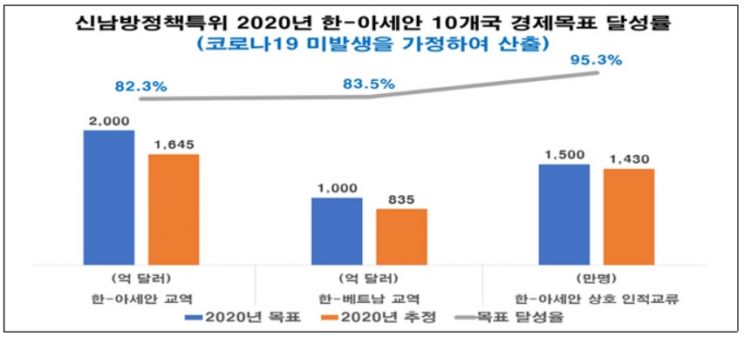
The FKI estimated that if COVID-19 had not occurred last year, the trade volume with the 10 ASEAN countries including Vietnam and Indonesia, as well as India, would have reached $164.5 billion. This figure was calculated by applying the average annual growth rate from 2010 to 2019 to last year's data. The policy achievement rate is 82.3%.
In terms of human exchanges, assuming no COVID-19 outbreak last year, the FKI estimated that 14.3 million people (95.3% of the target) would have been achieved. The FKI explained that since China's THAAD retaliation measures in 2016, domestic demand for Southeast Asian tourism and ASEAN countries' demand for K-pop experience tourism increased, leading to an average annual growth rate of 12.7% in Korea-ASEAN 10 countries human exchanges from 2010 to 2019, expanding to 12.68 million people in 2019.
The FKI interpreted that the New Southern Policy fell short of government targets because trade with five countries?Singapore, Malaysia, Indonesia, the Philippines, and Thailand?excluding Vietnam, has been declining since peaking in 2018. Last year, Korea's exports to Indonesia decreased by 18.2% due to reduced import demand for machinery parts, electronic devices, steel, and plastics.
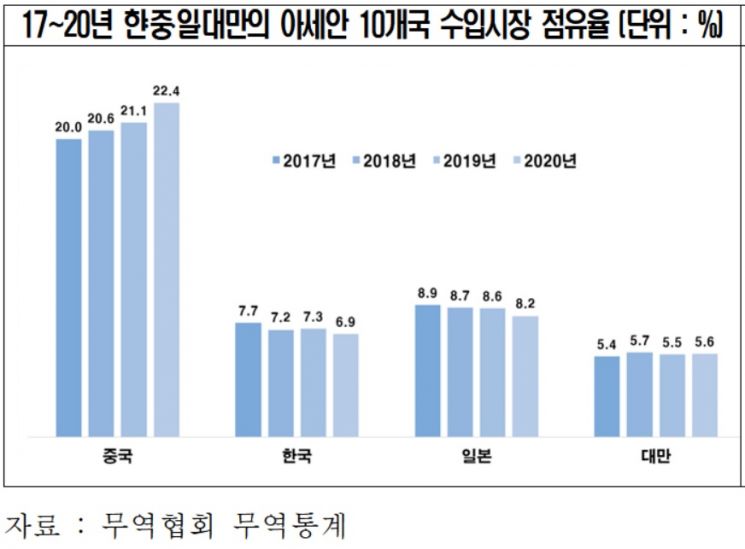
In particular, it was analyzed that Korea's position shrank as China expanded exports to ASEAN countries and Taiwan pursued its New Southbound Policy away from China following the 2018 US-China trade war. Looking at the market share of imports in the 10 ASEAN countries by country, Korea's share fell from 7.7% in 2017 to 6.9% last year, a drop of 0.8 percentage points, while China's share rose by 2.4 percentage points during the same period. Taiwan, which has pursued its New Southbound Policy since 2016, also increased its share by 0.2 percentage points during this period. Japan's share declined by 0.7 percentage points.
Kim Bongman, head of the FKI International Cooperation Office, said, "As the New Southern Policy has become a battleground in the US-China hegemony war, China and Japan are evenly deploying security and economic diplomatic capabilities targeting all ASEAN countries, whereas Korea's export dependence on Vietnam is excessively high compared to these countries within total ASEAN exports." He added, "The trade authorities should actively develop trade strategies to diversify export markets to ASEAN countries other than Vietnam."
© The Asia Business Daily(www.asiae.co.kr). All rights reserved.


















