Supply Decreases in Capital Region and Major Cities, Local Apartment Sales Surge
Seoul Apartment Market Overheats in H1 While Local Markets Face Frequent Undersupply
[Asia Economy Reporter Jo Gang-wook] An unusual trend is emerging in the apartment pre-sale market, which had been experiencing a so-called ‘bull market’ nationwide. While popular areas such as Seoul continue to see subscription competition rates of several hundred to one, some local regions have recently seen multiple complexes with zero applicants. As the bubble theory that housing price increases are excessive spreads, there are forecasts that the so-called regional subscription polarization will lead to a full-scale ‘sorting of the wheat from the chaff.’
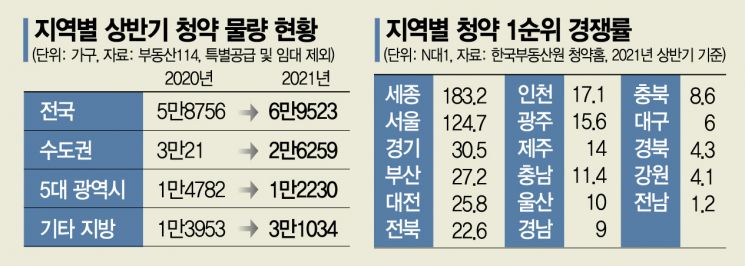
According to the Korea Real Estate Board’s Subscription Home on the 20th, the average subscription competition rate for apartments supplied in Seoul in the first half of this year was 124.7 to 1. The supply volume was 1,069 households, which sharply decreased to half the level of the first half of last year, while a massive 133,327 subscription accounts flooded in. This figure not only greatly exceeds the average competition rate of 97.1 to 1 in the second half of last year but is also the highest ever recorded on a half-year basis. As competition intensified, the minimum average score also rose to 60.9 points. It was literally a ‘bull market.’ The region with the highest subscription competition rate was Sejong City, where housing prices rose the most last year. A total of 71,464 applicants competed for 390 households (based on general supply), resulting in a competition rate of 183.2 to 1. Seoul also recorded a triple-digit competition rate of 124 to 1 due to a supply shortage, and Gyeonggi Province maintained a high competition rate of 30.5 to 1.
On the other hand, the average competition rate for apartments in Jeonnam Province was only 1.2 to 1. Gangwon (4.1 to 1), Gyeongbuk (4.3 to 1), Daegu (6 to 1), Chungbuk (8.6 to 1), and Gyeongnam (9 to 1) also recorded single-digit competition rates.
The temperature difference between popular and unpopular regions was also clear by complex. All nine complexes that recorded triple-digit competition rates in the first half appeared in areas with high housing demand such as Seoul, Gyeonggi, and Sejong. The highest subscription competition rate was seen at ‘Dongtan Station Dietre’ in Dongtan 2 New Town, Hwaseong-si, Gyeonggi Province, in May. The average competition rate reached 809.1 to 1, the highest ever recorded. ‘Wirye Xi The City’ in Chang-gok-dong, Sujeong-gu, Seongnam-si, Gyeonggi Province, and ‘Jayang Haneulchae Ber’ in Jayang-dong, Gwangjin-gu, Seoul, also showed competition rates of 617.6 to 1 and 367.4 to 1, respectively.
In contrast, unsold complexes appeared one after another in local areas. In the first half of the year, there were 32 unsold complexes nationwide. Representative examples include ‘Richmond Hill Cheorwon’ in Galmal-eup, Cheorwon-gun, Gangwon Province (0.01 to 1), ‘Gamgok Pogni’ in Gamgok-myeon, Eumseong-gun, Chungbuk Province (0.02 to 1), and ‘Dongseosan Yeongmu Yedaum’ in Eumam-myeon, Seosan-si, Chungnam Province (0.02 to 1).
Even in Daegu, where subscription overheating occurred until last year, an unusual trend was detected. Recently, ‘The Sharp Suseong O’Claire’ by POSCO Construction in Suseong-dong, Suseong-gu, and ‘Yonggye Station Prugio Artsber’ by Daewoo Construction both recorded undersubscription in the first priority.
This polarization is also analyzed to be influenced by regional supply imbalances. According to a survey by KB Kookmin Bank’s Liv Real Estate based on Real Estate 114 REPS data, the total supply volume in the first half of this year was 69,523 households (excluding special supply and rental), which superficially increased by 18.3% compared to the same period last year. However, when checked by region, the supply volume in the metropolitan area (26,259 households) and the five major metropolitan cities (12,230 households) decreased by 12.5% and 17.3%, respectively, while other local areas saw a whopping 122.4% increase to 31,034 households. In reality, the supply needed in the metropolitan area and large cities decreased, while the supply concentrated in local areas with relatively low demand. This is why voices pointing out the ‘statistical illusion’ are growing. For this reason, Minister of Land, Infrastructure and Transport Noh Hyung-wook also admitted this month that one cause of continued housing price instability was "a mismatch where the government’s supply measures did not meet the locations (such as downtown Seoul) desired by the majority of demand groups."
Seo Jin-hyung, president of the Korea Real Estate Society (professor of business administration at Gyeongin Women’s University), diagnosed, "The shift in new town supply direction is too late, so polarization between Seoul and local areas will worsen in the second half of the year. Although housing prices will rise, phenomena that distort statistics are appearing as transaction volumes plummet."
© The Asia Business Daily(www.asiae.co.kr). All rights reserved.
![Clutching a Stolen Dior Bag, Saying "I Hate Being Poor but Real"... The Grotesque Con of a "Human Knockoff" [Slate]](https://cwcontent.asiae.co.kr/asiaresize/183/2026021902243444107_1771435474.jpg)











