During Summer Peak Power Period, One-Third of Nuclear Reactors Under Maintenance
If Shin Hanul Units 1 and 2 Had Operated as Scheduled, Power Reserve Would Have Been Ample
Prime Minister's Direct Nuclear Safety Commission Also Criticizes 'Zigzag' Actions
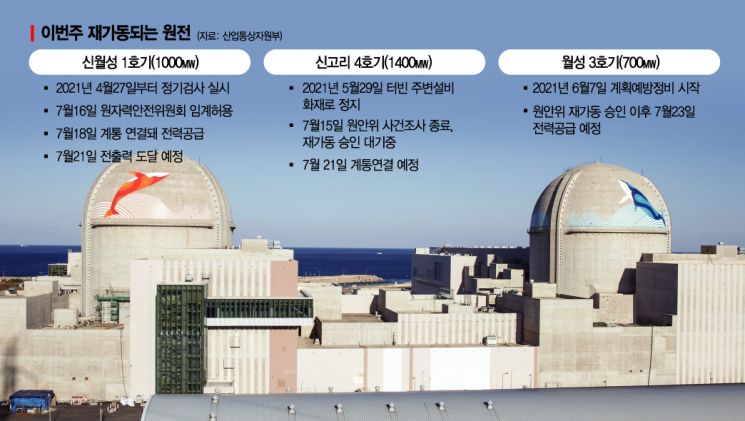
[Sejong=Asia Economy Reporter Kwon Haeyoung] The government’s decision to issue a 'total power mobilization order' by bringing forward the operation of two out of three nuclear power plants restarting this week is due to concerns over a power supply crisis caused by the heatwave. Critics argue that the Moon Jae-in administration’s rapid push for coal phase-out and nuclear phase-out policies underestimated power demand, leading to supply instability. The Nuclear Safety and Security Commission, which had repeatedly delayed approval for nuclear plant restarts, now appears to be approving restarts amid blackout concerns, prompting criticism that even the government is showing a zigzag approach under the current administration’s nuclear phase-out stance.
◆If Shin Hanul Units 1 and 2 had been operational, power reserves would have increased= According to the power industry on the 20th, if Shin Hanul Units 1 and 2 had been operated as originally scheduled and Wolseong Unit 1 had not been prematurely shut down, the power reserve this summer would have significantly increased.
Originally, Shin Hanul Unit 1 was scheduled to begin commercial operation in April 2018, and Shin Hanul Unit 2 in February 2019. However, the Nuclear Safety and Security Commission delayed approval citing safety concerns such as the risk of airplane collisions and potential attacks by North Korea’s long-range artillery, and only granted operation permission on the 9th, 15 months after completion. Wolseong Unit 1, which was scheduled to operate until 2022, was also prematurely shut down.
Considering that Shin Hanul Units 1 and 2 have generation capacities of 1.4GW each, and Wolseong Unit 1 has a capacity of 0.6GW, if these three nuclear plants had operated this summer, the reserve capacity would have increased by 3.4GW. According to estimates by the Ministry of Trade, Industry and Energy, the reserve margin, which indicates power surplus, is between 4 and 8.3GW during the peak power periods in the fourth week of July and the second week of August, below the stable threshold of 10GW. However, with the additional 3.4GW from Shin Hanul Units 1 and 2 and Wolseong Unit 1, the reserve margin could have been secured at 7.4 to 11.7GW. Therefore, there would have been no need for the government to hasten maintenance and restart approvals to bring nuclear plants online early amid blackout concerns.
◆One-third of nuclear plants are offline... "Reserve margin decline due to power supply and demand forecasting failure"= Some argue that the summer power supply concerns stem from the government’s lax demand forecasting.
According to Korea Hydro & Nuclear Power, as of this morning, 17 out of 24 domestic nuclear reactors are operational. Initially, only 16 were operating, but Shin Wolseong Unit 1 started operation on the 18th, increasing the number to 17. During the summer peak period, one-third of nuclear plants are under maintenance, and considering the power supply situation, it is argued that nuclear plants like Shin Hanul Units 1 and 2 should have been operated as scheduled or maintenance schedules adjusted.
Professor Jeong Dongwook of Chung-Ang University’s Department of Energy Systems Engineering said, "Nuclear plant maintenance is usually concentrated in spring and autumn, outside the summer peak period. However, this year, more than 30% of domestic nuclear plants are offline during the summer when power demand surges, indicating that the government failed to plan maintenance schedules according to the power supply situation."
In response, Korea Hydro & Nuclear Power explained, "Because nuclear plants have maintenance cycles, it is not possible to adjust maintenance schedules to avoid the summer peak period," adding, "The adjustable period is only about two weeks."
◆Prime Minister’s direct oversight of NSSC shows zigzag approach= The Nuclear Safety and Security Commission (NSSC), which had repeatedly delayed approval for nuclear plant restarts citing safety, now appears to be approving restarts amid blackout concerns, leading to criticism of the government’s zigzag approach under the current administration’s nuclear phase-out policy. In fact, Shin Wolseong Unit 1 and Shin Kori Unit 4, which are being brought online this week, are reported to have been started earlier than initially expected by as little as a week to as much as a month.
Prime Minister Kim Boo-kyum also stated the day before, "As the reserve power is expected to be at its lowest level this week, we will closely manage power supply and demand, actively manage demand, and bring forward the operation of nuclear plants under maintenance." There are criticisms that it is inappropriate for the Prime Minister to directly announce the 'early deployment' of nuclear plants. Although the NSSC is an independent body, it is under the Prime Minister’s direct jurisdiction, so it cannot be completely free from the Prime Minister’s influence.
Professor Jeong said, "If Shin Hanul Units 1 and 2 had operated as scheduled, such power supply instability would not have occurred," emphasizing, "The role of nuclear power as a stable power source is important." Given this incident reaffirmed the importance of nuclear power, there are calls for the government to break away from its nuclear phase-out obstinacy and normalize the policy by approving the operation of Shin Hanul Unit 2 and resuming construction of Shin Hanul Units 3 and 4.
© The Asia Business Daily(www.asiae.co.kr). All rights reserved.

















