Fear of Delta Variant Spurs Clear Risk Aversion
10-Year Government Bond Yield Hits Lowest in About 5 Months
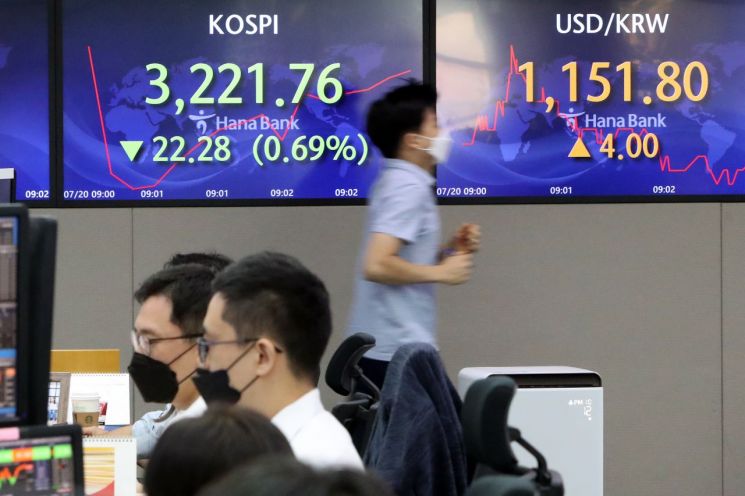
[Asia Economy Reporter Eunbyeol Kim] Amid fears of the resurgence of the COVID-19 Delta variant, a 'risk aversion' phenomenon has become prominent, pushing the KRW-USD exchange rate to a new intraday high. As investors flock to safe-haven assets, the US dollar has strengthened, while the Korean won, classified as a relatively risky asset, has depreciated. Experts predict that the KRW-USD exchange rate, which has surpassed 1,150 won, could rise further to the 1,160 won range. With funds flowing into safe government bonds, government bond yields are on a downward trend.
On the 20th, in the Seoul foreign exchange market, the KRW-USD exchange rate opened at 1,152.0 won, up 4.2 won from the previous day, setting a new intraday high. The exchange rate re-entered the 1,150 won range for the first time in four trading days, surpassing the 1,151.90 won recorded on the 14th. The intraday high is the highest since October 8 last year (1,158.8 won). The KRW-USD exchange rate has risen sharply by more than 25 won just this month.
The 10-year government bond yield fell by 5.8 basis points (1bp = 0.01 percentage points) to 1.914%, marking the lowest level in about five months. The 3-year government bond yield also traded down 4.0 basis points to 1.419%.
The main factor fueling investors' risk aversion is the spreading concern over the COVID-19 Delta variant both domestically and internationally. The US Dollar Index, which measures the dollar's value against the currencies of six major countries, stood at 92.85 around 8 p.m. Eastern Time on the 19th (local time). This is the highest level since early April. US economic broadcaster CNBC reported, "On this day, the dollar appreciated by about 1% relative to the Canadian dollar, Australian dollar, and New Zealand dollar," adding, "Safe-haven currencies such as the Japanese yen and Swiss franc also showed an upward trend." Seungji Jeon, a researcher at Samsung Futures, explained, "Concerns have increased with talk of the Lambda variant following Delta, and uncertainty has grown over the slowing momentum of economic recovery that had rebounded after COVID-19. The shift toward tightening monetary policies in major countries and fears of early tightening by the Federal Reserve due to rising US inflation also seem to be factors."
The stronger-than-expected US dollar value is also attributed to Europe's slower economic recovery compared to the US. The US dollar value is often determined relative to the euro, and Europe's slow vaccine rollout has resulted in a modest economic recovery. Additionally, the Chinese government's efforts to curb excessive yuan appreciation have contributed to the depreciation of the won, which tends to move in tandem with the yuan.
Experts have repeatedly raised their exchange rate forecasts for the second half of the year, anticipating the rate could reach the 1,160 won range. Securities firms' KRW-USD exchange rate forecasts have been revised upward from 1,130 won in the first half of this year to 1,150 won last month, and now to the 1,160 won range. However, Korea's current account surplus, driven by its export-led economy, continues to record surprises, acting as a factor restraining the rise in the KRW-USD exchange rate. The steady recovery in exports is continuously bringing in dollars.
© The Asia Business Daily(www.asiae.co.kr). All rights reserved.

















