Interview with Jin Gyomun, CEO of EasyFarm
Leading AgTech Pioneer Integrating IT with Agriculture and Livestock
Introducing Blockchain Technology to Pig Farms for Full Production-to-Consumer Traceability
Applying Smart Factory Model to Distribution Centers, Enhancing Farm Productivity
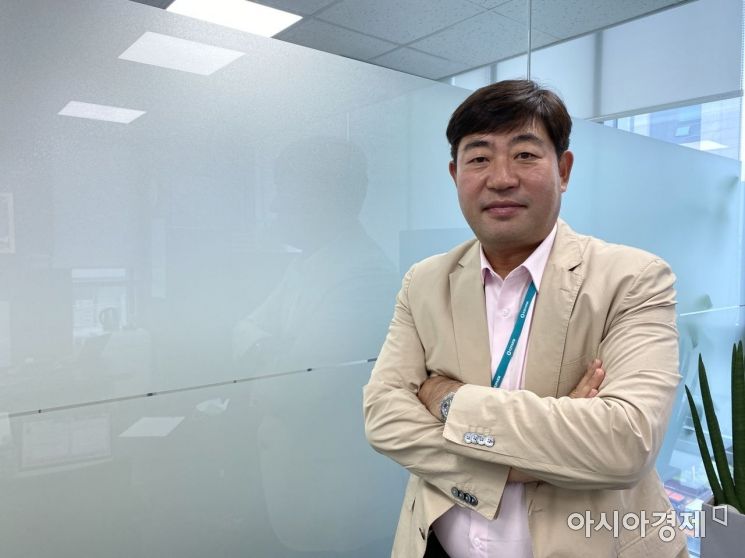 Jin Gyo-moon, CEO of EasyFarm and a first-generation venture entrepreneur, explained, "While the IT industry, represented by platforms, is a red ocean, the agricultural sector is a new market requiring technological innovation, which led me to challenge AgTech." Photo by Kim Hee-yoon
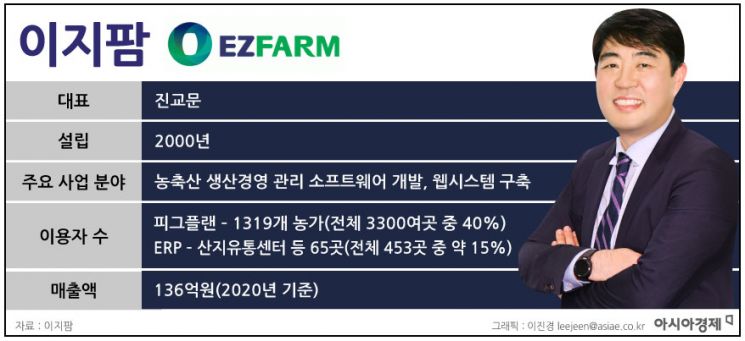
[Asia Economy Reporter Kim Heeyoon] In the pig farming industry, where production volume is key, efforts are underway to improve pig quality by adopting IT technologies that efficiently manage fattening pigs. EasyFarm has focused on this market demand and is providing the solution ‘PigPlan,’ which applies IT technologies such as artificial intelligence and blockchain to pig farming sites, offering objective and systematic indicators. PigPlan transparently tracks the history from the moment a sow gives birth to piglets through growth, sale, and consumption, helping efficient pigsty management. It has already been adopted by 4 out of 10 domestic pig farms, proving its effectiveness.
Jin Gyomun, CEO of EasyFarm, explained, “While the IT industry represented by platforms is a red ocean, agriculture is a new market requiring technological innovation, which led us to challenge agtech.” Jin graduated from Seoul National University with a degree in Computational Statistics, worked at Samsung Electronics and Sambo Computer, and founded the online education company iBillSoft, which he took public, making him a first-generation venture entrepreneur.
Now in its 21st year, EasyFarm has introduced customized IT solutions applying artificial intelligence (AI), big data, and blockchain technology to agricultural and livestock farms. In particular, PigPlan has demonstrated with numbers that data-driven systematic livestock management can lead to improved production efficiency. According to EasyFarm, the PSY (pigs per sow per year) of farms using PigPlan in 2020 was 23.5 heads, an increase of 1.8 heads from 21.7 heads in 2010. This is 2 heads more than the 2020 PSY of 21.5 heads analyzed from farms using HanDonFarms of the Korea Pork Producers Association, which is close to the national average.
AI Technology Narrowing the Gap Between Production and Shipment Numbers
In pig farming, reducing the gap between PSY and MSY (marketed pigs per sow per year) has been a long-standing challenge. The average PSY of domestic pig farms is 21 heads, while the average MSY is 17.9 heads, meaning about 3 pigs die annually. EasyFarm has built a big data-based cloud system to increase production by focusing on sow management with PigPlan and to ensure that piglets born do not die but grow well. Data collected in real time from individual pigs is recorded and managed on the blockchain.
Among over 3,300 pig farms nationwide, PigPlan is used in 1,319 farms, managing 434,113 sows and holding 1.2 billion accumulated data records. CEO Jin added, “Just as we focused on sow management to increase PSY, we are now in the final stages of developing a solution to manage fattening pigs with artificial intelligence to increase MSY, which is scheduled for release next year.”
Initially, EasyFarm focused on the smart farm business. However, given the small scale of farmland and low annual income in domestic agriculture, the smart farm business, which focused on productivity improvement, always faced consumption issues. Therefore, EasyFarm shifted its focus from production sites to regional distribution centers. CEO Jin explained, “Instead of productivity improvement, which cannot guarantee supply and demand, we have promoted informatization projects that build information systems at key institutions such as regional distribution centers, comprehensive rice processing centers, and agricultural product processing centers to communicate with farms.”
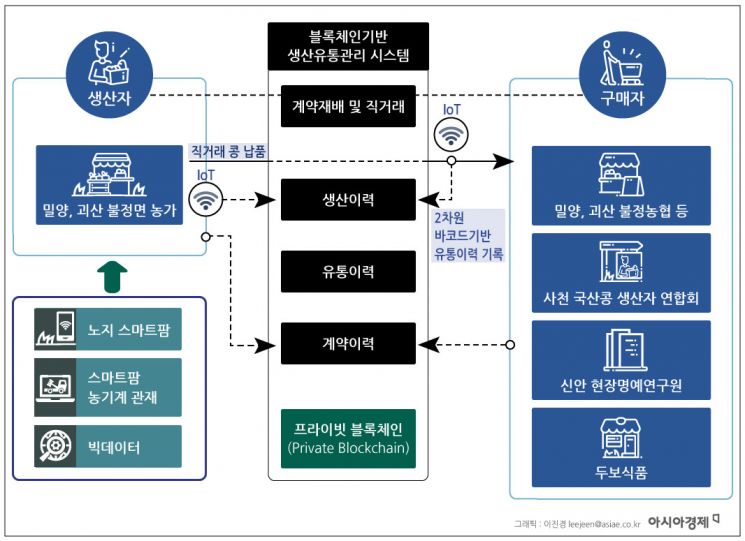 Blockchain-based production and distribution management system built by EasyFarm. Graphic by Jin-kyung Lee, Designer
Introducing Smart Factory Concepts to Regional Distribution Centers
For example, environmental data from tomato farms is compared with shipment grading data from regional distribution centers to check differences between farms and any abnormalities during the growth process. EasyFarm’s solution, which proposed a data agriculture construction model, suggested growth in the agricultural big data ecosystem. CEO Jin said, “If IoT-based sorting machines, blockchain, and the global standard barcode GS1 are applied to farm contracts, receipt, storage, sorting, and shipment at regional distribution centers, the informatized and accumulated big data can be used to predict future cargo volume and prices, enabling distribution intelligence.” He emphasized, “Collecting and integrating data from all stages of the value chain from production to consumption through regional distribution centers is the most suitable Korean-style smart farm for the reality of Korean agriculture.”
To ensure transparent traceability of agricultural and livestock products, EasyFarm began blockchain development in 2018 and introduced the agricultural product production and consumption management system ‘Blocery’ combined with blockchain earlier this year. According to EasyFarm, as the traceability and contract purchases of agricultural products using the Blocery solution increase, the amount of staked tokens also grows, increasing their value. Blocery, which is also traded as a cryptocurrency, has been recognized for its growth potential, being listed in Korean won on Bithumb and Gopax.
CEO Jin stated, “Every year, 16 billion tons and 1,500 trillion won worth of food is wasted during production, distribution, and consumption processes, which is a problem that can be solved through supply chain technology.” He expressed his ambition, saying, “We will build a transparent agricultural and livestock supply chain using IT technologies such as blockchain, big data, and AI, while establishing ourselves as a leading agtech company through global market expansion and token economy growth.”
© The Asia Business Daily(www.asiae.co.kr). All rights reserved.
![User Who Sold Erroneously Deposited Bitcoins to Repay Debt and Fund Entertainment... What Did the Supreme Court Decide in 2021? [Legal Issue Check]](https://cwcontent.asiae.co.kr/asiaresize/183/2026020910431234020_1770601391.png)

















