Last Year's Actual Operating Rate 49%
Frequent Cases of Not Operating Due to High Generation Cost
Confused Between Eco-friendliness and Economic Feasibility
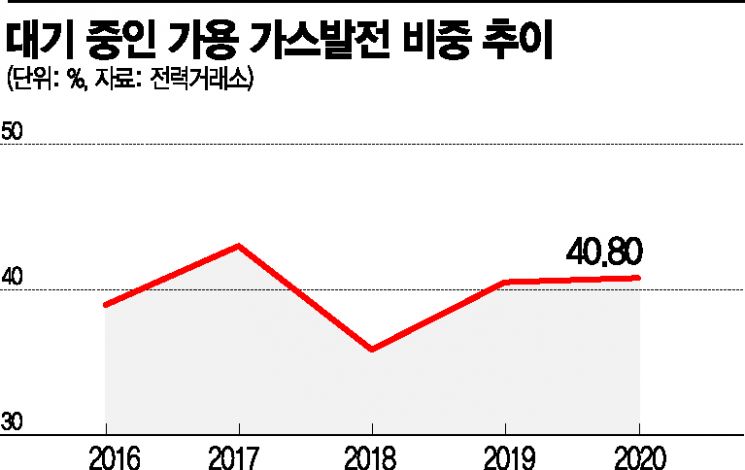
[Sejong=Asia Economy Reporter Joo Sang-don] The operating rate of liquefied natural gas (LNG) power generation facilities, regarded as an alternative to coal power, has fallen below 50% for the first time in four years. The 'operational reserve shutdown rate,' which indicates the standby status among available facilities, also showed an upward trend for two consecutive years. This is the result of LNG power being deprioritized in the generation order based on economic feasibility. Following nuclear phase-out, even LNG power, which is considered more eco-friendly than coal, has shown poor performance, leading to criticism that the Moon Jae-in administration's energy policy is struggling to find a balance between 'eco-friendliness' and 'economic feasibility.'
According to the Korea Power Exchange on the 19th, the actual operating rate of LNG power generation facilities was 49.12% last year. After exceeding 50% in 2017, it remained above 50% for three consecutive years but fell below half again after four years. The operational reserve shutdown rate also increased by 0.29 percentage points to 40.80% last year compared to the previous year. This rate had dropped to 35.87% in 2018 but jumped to 40.51% in 2019. This means that 4 out of 10 LNG power plants remained shut down for two consecutive years.
The low operating rate of normally functioning gas power plants is due to the high generation cost. As of last year, the LNG fuel cost was 71.83 KRW per kWh. In contrast, nuclear power was 6.04 KRW, and bituminous coal was 60.46 KRW. From January to July this year, the LNG cost rose further to 79.62 KRW. A power company official said, "Whether to operate is decided according to the Korea Power Exchange's economic dispatch, so LNG power is mostly pushed to the lower priority."
However, this contradicts the policy direction. Pursuing eco-friendliness while considering economic feasibility excludes intermediate fuels like LNG from power generation. Last year, the actual operating rate of coal power was 73.1%.
Despite this situation, the facility capacity is expected to steadily increase. According to the 9th Basic Plan for Electricity Supply and Demand, 24 coal power generation facilities will be sequentially converted to LNG power. Accordingly, the LNG power capacity will increase from 41.3 GW last year to 58.1 GW by 2034.
Professor Jeong Dong-wook of the Department of Energy Systems Engineering at Chung-Ang University pointed out, "The government is expanding renewables along with nuclear and coal phase-out as part of the energy transition policy, but in the process, it is excessively increasing LNG power facilities."
© The Asia Business Daily(www.asiae.co.kr). All rights reserved.

















