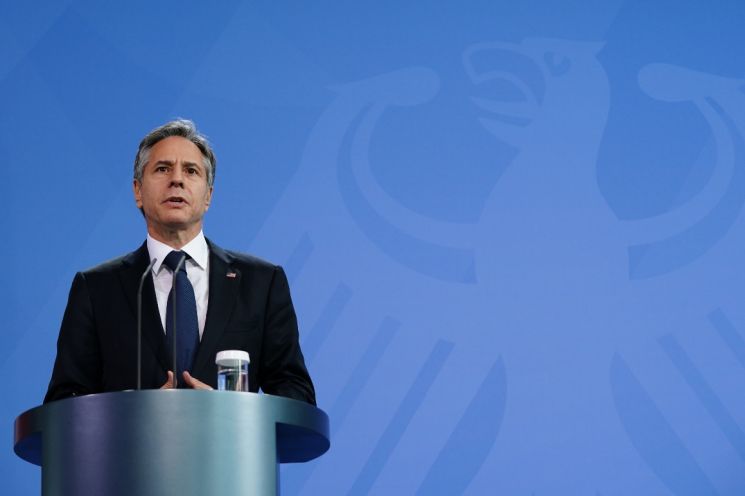
[Asia Economy Reporter Yujin Cho] U.S. Secretary of State Tony Blinken has presented the promotion of human rights and democracy as the top priority for American diplomats, while also conveying guidelines that it is acceptable to acknowledge America's own flaws in this process. This move appears to be a response to the growing narrative of a human rights and democracy crisis within the U.S., amid America's intensified campaign against China over human rights abuses in the Xinjiang Uyghur Autonomous Region.
Politico obtained a lengthy diplomatic cable sent by Blinken on the 16th (local time) to U.S. embassies worldwide and reported accordingly. In the cable, Blinken stated, "Protecting and strengthening democracy and human rights globally aligns with U.S. national interests and enhances national security," adding that the U.S. is no exception to this.
Politico described the cable as containing specific goals of President Joe Biden, who has consistently emphasized human rights and democracy promotion as key values throughout the 2020 election process and since taking office, and assessed it as a strategic break from the Trump administration, which largely ignored human rights issues.
Blinken pointed out that democracy faces challenges from populists and authoritarian forces, noting, "The United States is not exempt from this trend due to political polarization, misinformation, and low trust in government."
He emphasized that when working to promote human rights and democracy abroad, "We must not demand more from other countries than we demand from ourselves," explaining, "This means acknowledging our flaws and not sweeping them under the rug. We will confront them openly and transparently."
He added, "(This attitude) may be painful and even ugly, but such honesty can disarm critics and skeptics who weaponize America's flaws to undermine U.S. leadership."
Although Blinken did not mention specific criticisms, Politico interpreted this as possibly targeting China and Russia, which have questioned the credibility of America's human rights promotion by highlighting issues such as racial discrimination.
Since the death of Black man George Floyd due to police excessive force in May last year and the January storming of the U.S. Capitol, concerns about a human rights and democracy crisis have been raised domestically, and countries like China and Russia have used these incidents to argue that "the U.S. has no right to speak about democracy and human rights in other countries."
However, Politico noted that Blinken's call to acknowledge America's imperfections could face backlash. Amid fierce debates between conservatives and progressives over 'critical race theory,' which views racial discrimination in the U.S. as a structural problem, this stance could provoke opposition from the Republican Party.
For example, when Blinken recently officially invited a UN special rapporteur to investigate racial discrimination and minority rights issues in the U.S., Republican Senator Marco Rubio criticized the Biden administration for focusing more on issues affecting Americans than on more urgent matters like Cuba.
At that time, Blinken reaffirmed the Biden administration's position, stating, "As President Biden has repeatedly made clear, great nations like ours do not hide their flaws but openly acknowledge them and commit to transparent improvement."
Blinken has instructed diplomats to regularly engage with local human rights organizations and civil society representatives in their respective countries. Additionally, when State Department officials travel abroad, they are to include meetings with human rights groups in their schedules, and State Department officials have been directed to consider all available tools, including military aid and visa bans.
A senior State Department official explained that this approach will make the U.S. a stronger and more trustworthy nation in the long term, and that the best tactics in each situation should be considered on a case-by-case basis.
© The Asia Business Daily(www.asiae.co.kr). All rights reserved.

















