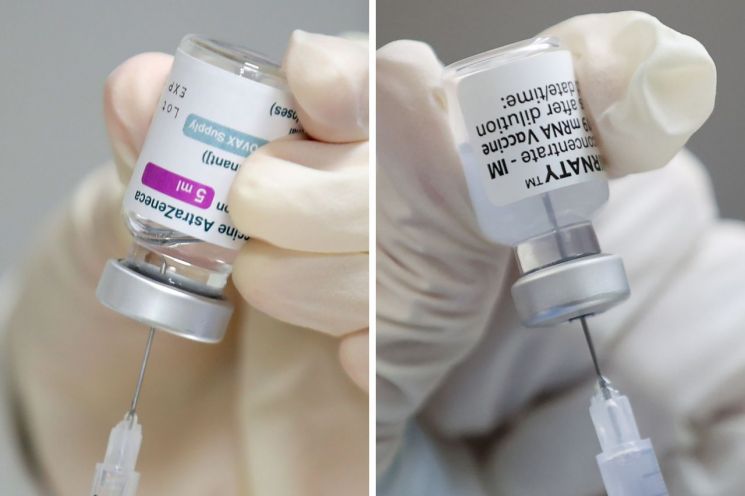
 Preparation scenes for AstraZeneca vaccine (left photo) and Pfizer vaccine (right photo).
 [Photo by Yonhap News]
[Asia Economy Reporter Seoyoung Kwon] As the Delta variant of COVID-19 rapidly spreads, the number of infections in Israel, once called a 'vaccine advanced country,' is also surging.
According to the Israeli Ministry of Health on the 17th (local time), the number of new COVID-19 cases in Israel reached 11,118. The local health ministry added that this is the first time in four months that new cases have exceeded 1,000. The positivity rate is 1.58% of total tests, and the reproduction number, which indicates how many people one infected person transmits the virus to, is 1.37.
In Israel, out of a total population of about 9.3 million, approximately 5.22 million people, or 56%, have completed two doses of the vaccine. Thanks to this rapid vaccination rate, the Israeli government once lifted all quarantine measures, including indoor mask mandates. However, during the period when these measures were lifted, the Delta variant spread rapidly, causing daily new cases, which were in single digits earlier last month, to exceed 1,000, raising concerns.
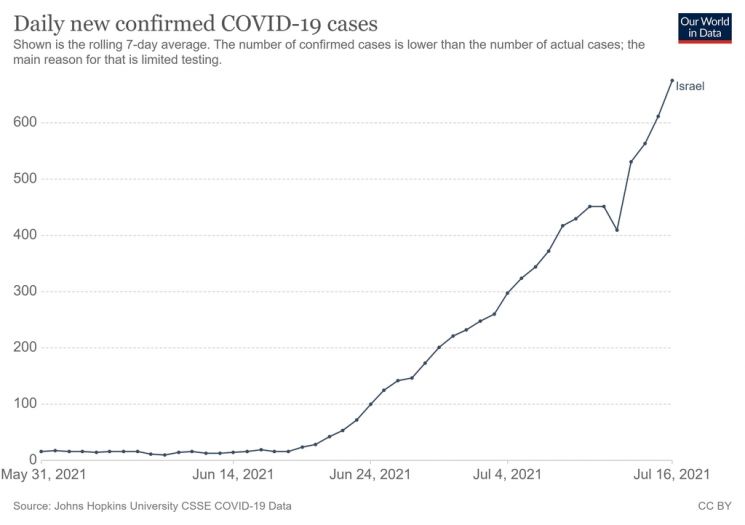 Trend of daily new confirmed COVID-19 cases in Israel after late May (7-day moving average) [Photo by Our World in Data website capture]
The Delta variant was first identified in India and has spread to China, the United States, Europe, and other regions. Its transmissibility is 64% higher than the Alpha variant discovered in the UK, making it the most contagious COVID-19 variant identified so far.
Experts predict that current vaccinations can somewhat prevent the Delta variant but not completely. Earlier, the UK Health Security Agency reported that after two doses, the Pfizer vaccine is 87.9% effective and the AstraZeneca (AZ) vaccine is 59.8% effective against the Delta variant. These rates are lower than the 91.3% and 81.5% effectiveness against the original COVID-19 virus. Both vaccines showed only about 30% effectiveness against the Delta variant after just one dose, which is relatively low.
In Israel, where most adults have been vaccinated, the increase in severe cases and deaths has been slight compared to the rise in confirmed cases. However, the fact that more than half of new cases and over 60% of severe cases are among vaccinated individuals remains a concern.
Israeli Prime Minister Naftali Bennett stated, "The Pfizer vaccine's effectiveness against the Delta variant is weaker than authorities had hoped," adding, "We do not know exactly how much the vaccine helps, but its effectiveness against the Delta variant is quite weak." He continued, "People believe the vaccine will completely solve the problem, but that is not the case. While the vaccine is effective in preventing COVID-19, it is not sufficient alone amid the rapid global spread of the Delta variant."
Meanwhile, the United Kingdom, another country hit hard by the Delta variant, maintains its stance to ease quarantine measures starting from the 19th (local time). Originally, the UK planned to lift all restrictions from the 21st of last month but postponed this once due to the spread of the Delta variant. However, with the Delta variant still spreading clearly, voices of concern have been raised worldwide regarding the UK's policy. Currently, the UK's daily COVID-19 cases exceed 50,000.
© The Asia Business Daily(www.asiae.co.kr). All rights reserved.


















