Landlord says tenants don't have to move out,
but worries about compensation after evicting them before move-in
Tenants say they don't have to leave,
but have already paid deposit for new rental
Frustrated over millions lost in sunk costs
[Asia Economy Reporter Onyu Lim] As the government and ruling party have withdrawn the regulation requiring a 2-year mandatory residence for reconstruction association members, cases of damage are emerging one after another. Unrealistic regulations proposed indiscriminately under the pretext of speculation prevention have been scrapped, leading to criticism that only landlords and tenants who acted in advance considering the enforcement have suffered unnecessary losses.
According to the real estate industry on the 18th, the National Assembly Land, Infrastructure and Transport Committee held a plenary session on the 13th and, after much difficulty, passed the amendment to the Urban and Residential Environment Improvement Act that nullified the '2-year mandatory residence' policy for reconstruction apartment association members. The plan to impose a residence obligation on reconstruction association members was a key part of the June 17 measures last year, but due to opposition from opposition party lawmakers, the law's passage was delayed and ultimately the provision was removed from the bill on that day.
Although the residence obligation plan was never implemented, association members and tenants who acted in advance are complaining of damages. Mr. A, who owns an apartment in the new town area of Mokdong, Yangcheon-gu, Seoul, is in a difficult situation due to the nullification of the 'reconstruction association member residence obligation.' Living in Bucheon, Gyeonggi Province, Mr. A reluctantly asked tenant Mr. B to move out to secure the association member's right to move in and planned to move into the old Mokdong apartment, but the government's policy withdrawal has put him in a tough spot. The tenant has already signed a contract for another jeonse (long-term deposit lease) house. Mr. A said, "Since I asked the tenant to move out on the premise of moving in, I cannot rent it out again," adding, "The house is small and old, and there are many inconveniences such as the parking lot, so I am worried."
Landlords like Mr. A who refused to renew lease contracts for residence purposes are now worried about compensation claims when signing new lease contracts, and landlords who moved in after evicting tenants are angry about the remodeling and moving costs already incurred. According to the new Lease Protection Act, if a landlord refuses a tenant's contract renewal request for residence reasons and accepts a new tenant, the landlord must compensate the highest amount among the following: △ three months' rent previously received from the existing tenant △ two years' worth of the difference between the rent received from the new tenant and the rent previously received from the existing tenant △ damages incurred by the existing tenant.
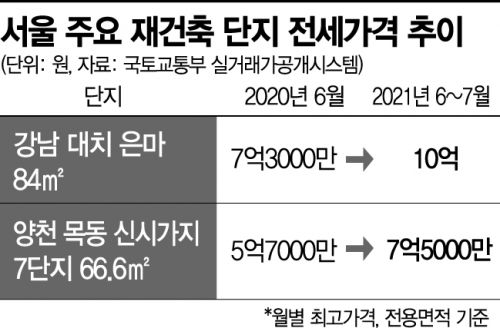
Tenants are also suffering damages. Especially tenants who were almost forced out due to the residence obligation find themselves in an absurd situation. They recall the struggles to prepare for soaring jeonse prices after the new Lease Protection Act. For example, the jeonse price of an 84㎡ (exclusive area) unit in Eunma Apartment, Daechi-dong, a representative reconstruction promotion complex in the Gangnam area of Seoul, soared from 730 million KRW just before the June 17 measures last year, which proposed the regulation, to 1 billion KRW currently.
The situation of tenants caught between the new lease contract and the withdrawal of the residence obligation regulation is even more serious. Mr. B, living in Eunma Apartment, recently found a new jeonse house, but the landlord Mr. C suddenly said, "You can stay longer," leaving him in a dilemma. Mr. C said, "I have already paid a deposit of 60 million KRW," and expressed frustration, asking, "Who will compensate for this sunk cost?"
A representative from D Real Estate Agency in Daechi-dong said, "There are quite a few tenants who reluctantly moved out due to concerns about their children's education," adding, "The policy is no child's play, and with the residence obligation regulation being nullified, inquiries have surged in just a few days."
Although landlords and tenants suffer greatly from the government's and ruling party's inconsistent policies, there is also a view that the withdrawal of this regulation could be positive for Seoul's jeonse market, which is suffering from a shortage of listings. Ham Young-jin, head of the Zigbang Big Data Lab, said, "The withdrawal of the residence obligation may not lower jeonse prices, but it is meaningful in that it reduces market disruption factors amid ongoing jeonse instability caused by the monthly rent conversion of jeonse and a decrease in move-in supply." However, concerns remain that the withdrawal of the regulation could fuel price increases in reconstruction complexes. Park Won-gap, senior real estate expert at KB Kookmin Bank, said, "Since residents can receive move-in rights without residing for two years, gap investments involving jeonse may increase in areas not designated as land transaction permission zones, potentially stimulating housing prices."
© The Asia Business Daily(www.asiae.co.kr). All rights reserved.


















