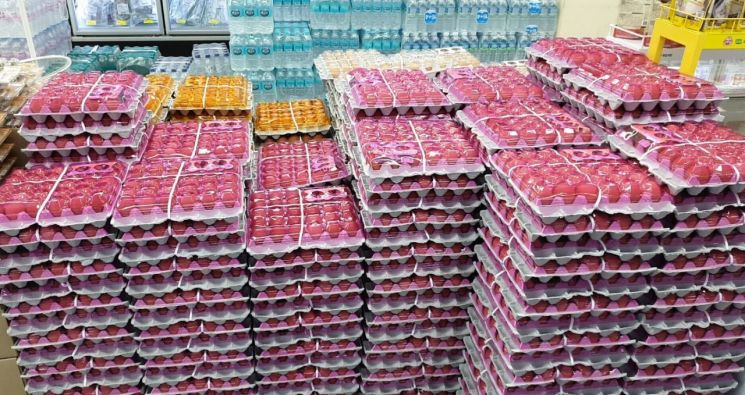
[Asia Economy Reporter Joo Sang-don] Although highly pathogenic avian influenza (AI) has not occurred for some time, egg prices have not fallen from the mid-7,000 won range.
According to the Livestock Products Quality Evaluation Service's Livestock Distribution Information and the Korea Agro-Fisheries & Food Trade Corporation (aT) on the 18th, the consumer price for one carton of eggs (30 extra-large eggs) was 7,531 won as of the 16th.
Since the highly pathogenic AI was confirmed at a poultry farm on November 28 last year for the first time in 2 years and 8 months, egg prices, which were in the mid-5,000 won range, rapidly rose and soared to 7,821 won on February 15.
The egg price inflation rate in the first half of this year, according to the National Statistical Portal of Statistics Korea, was 38.9%, marking the highest in four years since 2017.
The highly pathogenic AI, which was pointed out as the biggest factor driving up egg prices, has not occurred since April 7 at a meat duck farm in Jangheung, Jeonnam.
The reason egg prices are not falling is because a large-scale culling of laying hens has already been carried out, and egg demand has increased due to more home-cooked meals during the COVID-19 pandemic.
In the second half of the year, as the number of laying hens raised exceeds the average level, egg prices are expected to gradually stabilize. According to the 'Laying Hen Observation' report released last month by the Rural Observation Headquarters under the Korea Rural Economic Institute, the number of laying hens raised in June was 70.23 million, down 6.3% compared to the same period last year but 1.9% higher than the average year. Egg production was 40.5 million as of the 1st of last month, up 3.0% from the previous month, and is projected to increase to 42.99 million this month and 44.41 million next month.
© The Asia Business Daily(www.asiae.co.kr). All rights reserved.
!["The Woman Who Threw Herself into the Water Clutching a Stolen Dior Bag"...A Grotesque Success Story That Shakes the Korean Psyche [Slate]](https://cwcontent.asiae.co.kr/asiaresize/183/2026021902243444107_1771435474.jpg)
















