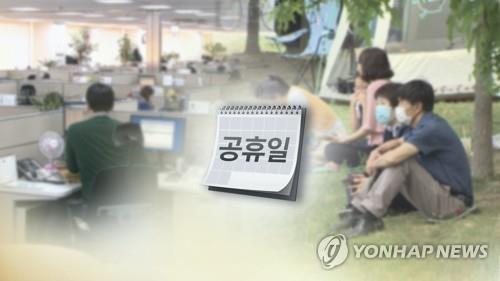
[Asia Economy Reporter Oh Ju-yeon] Criticism is emerging that the policy lacks consistency as the contents of the substitute holiday expansion bill, which passed the National Assembly last June, were significantly revised in the government's final confirmation plan.
The National Assembly proposed and passed a bill to apply substitute holidays to "all public holidays," but the government finalized the substitute holidays to apply only to "national holidays among public holidays." This means the number of substitute holidays has been reduced from the initially expected 15 days to 11 days, a decrease of 4 days.
Furthermore, calculating the average number of holidays per year over the next 10 years shows an increase of only 0.9 days, leading to criticism that the government ignored the National Assembly's legislative bill. Even the ruling party, which strongly promoted the policy under the slogan of "returning the red days," has lost face. There are concerns that the policy lacks credibility due to the discord between the ruling party and the government.
According to the National Assembly's Administrative Safety Committee, the standing committee responsible for substitute holidays, the originally passed bill stated that "if a public holiday falls on a Saturday, Sunday, or overlaps with another public holiday, it can be designated and operated as a substitute holiday." Public holidays include national holidays, January 1st, Lunar New Year holidays, Buddha's Birthday, Children's Day, Memorial Day, Chuseok holidays, Christmas, and others. Accordingly, it was announced that 15 public holidays would be subject to substitute holidays, but the announcement from the Ministry of Personnel Management the day before significantly reduced the scope.
If only national holidays are designated as substitute holidays, as announced by the Ministry of Personnel Management, the total number of substitute holidays will be 11 days. This is 4 days more than the current 7 substitute holidays applied only to Lunar New Year, Chuseok holidays, and Children's Day, but 4 days less than the bill passed by the National Assembly last month.
Calculating the increase in holidays due to the application of substitute holidays over the next 10 years from 2022 results in an average increase of only 0.9 days per year.
The Ministry of Personnel Management announced that it will propose a revision to the "Regulations on Public Holidays of Government Offices" (Presidential Decree) as a follow-up measure to the "Public Holidays Act" passed by the National Assembly the day before. Accordingly, it was finalized that substitute holidays will only be applied when "resting national holidays (March 1st Movement Day, Liberation Day, National Foundation Day, Hangul Day)" overlap with weekends, dashing expectations that all public holidays could be taken as substitute holidays.
Some say that the process of passing the substitute holiday law was noisy for an increase of only 0.9 days in holidays.
A Democratic Party official said, "The party leadership loudly promised to 'return the red days' and there was controversy over the exclusion of workplaces with fewer than five employees, but compared to that, the result is very disappointing," adding, "The discord with the government could only reduce trust in the policy."
Meanwhile, the "Public Holidays Act" passed by the National Assembly last month was reported at the time of passage to apply substitute holidays to all public holidays, but the government, after consultation with related ministries and collecting opinions from relevant organizations, finalized the application of substitute holidays only to "national holidays that are public holidays." To allow flexible operation of substitute holidays, the designation and operation were delegated to the Presidential Decree, but by revising the scope of substitute holiday designation itself rather than detailed matters such as moving holidays to the preceding Friday or following Monday, the original plan was significantly rolled back.
Accordingly, public holidays that are not national holidays, such as Buddha's Birthday and Christmas, are excluded from substitute holidays. Therefore, the remaining substitute holidays for this year are not four days including Liberation Day, Hangul Day, National Foundation Day, and Christmas, but only three days: Liberation Day, Hangul Day, and National Foundation Day.
© The Asia Business Daily(www.asiae.co.kr). All rights reserved.

















