Ministry of Land, Infrastructure and Transport Announces Legislative Notice for Amendment to Enforcement Decree of Special Act on Public Housing on the 16th
[Asia Economy Reporter Jo Gang-wook] More than 70% of the housing built through the core ‘Urban Public Housing Complex Project’ of the February 4th supply plan will be supplied as public sale housing. Public owner-occupied housing with equity accumulation and profit-sharing types, as well as public rental housing, will be built at rates of 10-20% each.
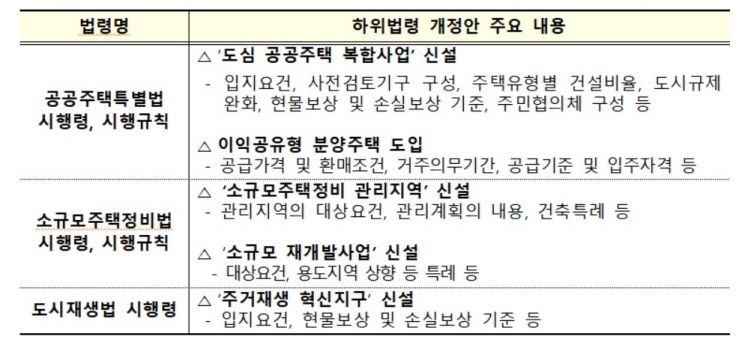
The Ministry of Land, Infrastructure and Transport announced on the 16th that it will give prior notice of the amendment to the Enforcement Decree of the “Special Act on Public Housing” containing these details. The amendment mainly specifies the details of the Urban Public Housing Complex Project presented in the February 4th plan and includes the operation method of profit-sharing type public owner-occupied housing.
The Urban Public Housing Complex Project is a project to supply housing through high-density development led by public institutions in station areas, low-rise residential areas, and semi-industrial zones. It proceeds as a public-led fast track by easing urban regulations such as floor area ratio incentives and simplifying approval procedures including integrated review.
According to the amendment, more than 70% of urban public housing will be supplied as general public sale housing. For landowners without the capacity for additional payment, public owner-occupied housing (profit-sharing type, equity accumulation type) is set at 10-20% of the total. Public rental housing will be supplied at 15-20% in station area projects and 10-20% in other types.
The floor area ratio in residential areas can be increased up to 120% of the legal limit. If the district area is less than 50,000㎡, the obligation to secure urban parks or green spaces is exempted. The project target requires that 40-60% of buildings in the area be aged buildings over 20 years old.
To receive in-kind compensation through equity accumulation or profit-sharing type sale housing, one must be a non-homeowner or own only one house within the district as of the announcement date of the compensation plan. If one household or individual owns more than one piece of land, only one house will be supplied, and if two or more people share one house or one piece of land, only one house will be supplied. It is possible to receive two houses within the total compensation amount or the residential exclusive area of the previous house. However, in this case, one house must be a small house with an exclusive area of 60㎡ or less.
The supply price of profit-sharing type sale housing is determined through negotiation between the public housing operator and the landowner within the range of 50-80% of the sale price. The repurchase price of profit-sharing type sale housing is calculated by applying the disposal profit-sharing standard to the arithmetic average of two or more appraisal values at the time of repurchase. Both in-kind compensation recipients and general non-homeowners are subject to a 5-year residence obligation.
For public sale housing and public owner-occupied housing, the general supply ratio will be expanded to 50%, up from the current 15% for public sale housing. The current general supply method, which selects 100% sequentially, will be changed to 70% sequential and 30% lottery. Eligibility is limited to members of non-homeowner households for more than 3 years. If the sale price of public sale housing (60㎡ or less) exceeds 900 million KRW, income requirements are excluded.
In addition, the Ministry of Land announced prior notice of amendments to the Enforcement Decrees of the “Special Act on Vacant and Small House Maintenance” and the “Special Act on Urban Regeneration Activation and Support.” Accordingly, the project implementation area for private street housing maintenance projects will be doubled from 10,000㎡ to 20,000㎡. Also, the area of the newly established Residential Regeneration Innovation District under the amended Urban Regeneration Act is limited to within 20,000㎡ to prevent excessive land acquisition.
© The Asia Business Daily(www.asiae.co.kr). All rights reserved.

















