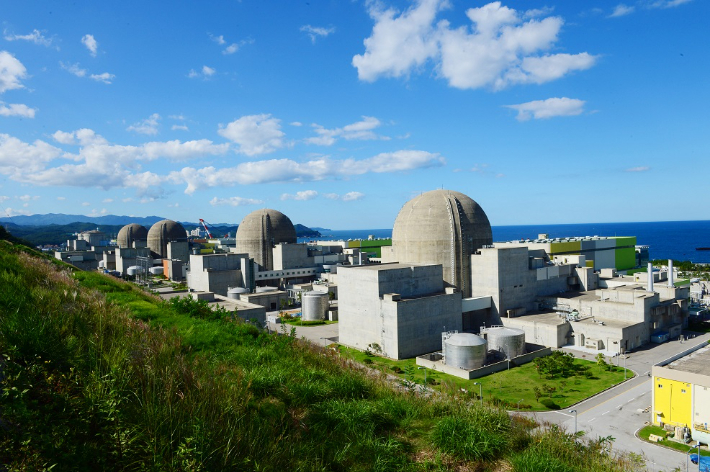
[Asia Economy Yeongnam Reporting Headquarters Reporter Dongguk Lee] Gyeongbuk Province announced on the 16th that it will actively promote a research project to analyze the damage to the Gyeongbuk nuclear power plant region caused by the government's energy transition policy and to prepare countermeasures.
The related project kickoff meeting will be held at 2 p.m. on the same day at the East Coast Regional Headquarters, attended by the head of the East Coast Regional Headquarters of the province and nuclear power officials from Gyeongju, Yeongdeok, and Uljin. The Daegu Gyeongbuk Institute will undertake the project, and the results are expected to be announced as early as November.
This research project analyzes the economic damage caused by the early shutdown of Wolseong Unit 1, the suspension of construction of Shin Hanul Units 3 and 4, the cancellation of Yeongdeok Cheonji Nuclear Power Units 1 and 2, and nuclear power plants scheduled for end of life due to the nuclear phase-out policy.
There are five nuclear power plants in Gyeongbuk Province scheduled to reach the end of their lifespan: Wolseong Unit 2 in 2026, Wolseong Unit 3 in 2027, Wolseong Unit 4 in 2029, Hanul Unit 1 in 2028, and Hanul Unit 2 in 2029.
To promote national projects responding to nuclear power, the project includes establishing a nuclear power coexistence national industrial complex, justifying the attraction of public institutions such as the relocation of the Nuclear Safety and Security Commission, and emphasizing the necessity of nuclear power in achieving carbon neutrality.
According to data presented at the Nuclear Safety Cluster Forum in 2018, the government's energy transition policy caused economic damage to the region estimated at about 9.5 trillion KRW and a reduction in employment of 13 million person-years.
At that time, the analysis only included the early shutdown of Wolseong Unit 1, suspension of construction of Shin Hanul Units 3 and 4, and cancellation of Yeongdeok Cheonji Nuclear Power Units 1 and 2, but this research project adds nuclear power plants scheduled for end of life. Considering opportunity costs such as delays in operating permits and the economic impact of the collapse of the nuclear ecosystem, the scale of damage is expected to increase.
Once the project results are announced, Gyeongbuk Province's policy is to strongly demand corresponding national project support, the prompt operating permit for the already completed Shin Hanul Unit 2, extension of operation for end-of-life nuclear power plants, and resumption of construction of Shin Hanul Units 3 and 4.
Governor Lee Cheol-woo emphasized, "Since nuclear power is regaining importance as a base load and low-carbon energy source, advanced energy countries such as the UK and France are turning back from reduction to nuclear power plant construction and life extension operation," adding, "This research project will be the starting point to reveal the damage caused by the nuclear phase-out."
© The Asia Business Daily(www.asiae.co.kr). All rights reserved.

















