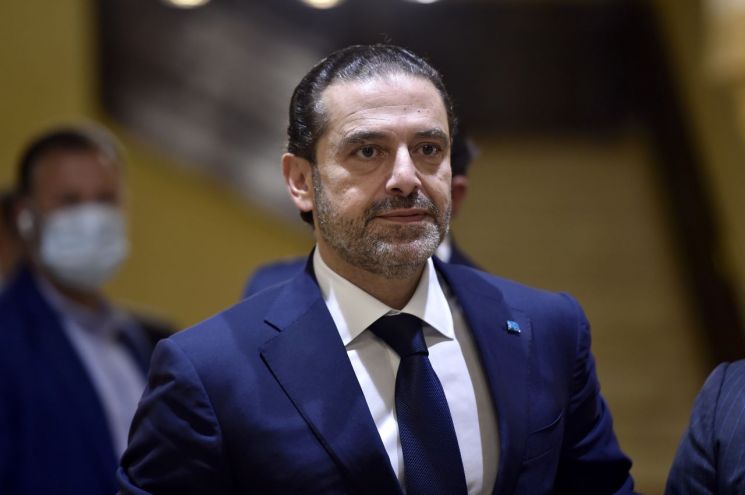
[Asia Economy Reporter Kim Suhwan] In the Middle Eastern country of Lebanon, the prime minister-designate has once again given up on forming a government and resigned amid intense political conflict.
As the worst economic crisis continues, political turmoil caused by the government vacuum is expected to prolong.
On the 15th (local time), Saad Hariri, Lebanon's prime minister-designate, expressed his intention to resign shortly after a 20-minute meeting with President Michel Aoun.
Hariri said, "There were disagreements on key issues. It is clear that we cannot agree with the president's opinion," adding, "I am giving up on forming the government."
The day before, Hariri met with President Aoun, submitted a list of 24 new cabinet members, and requested a response by that day, but it is reported that the president's side did not agree to the proposed cabinet formation.
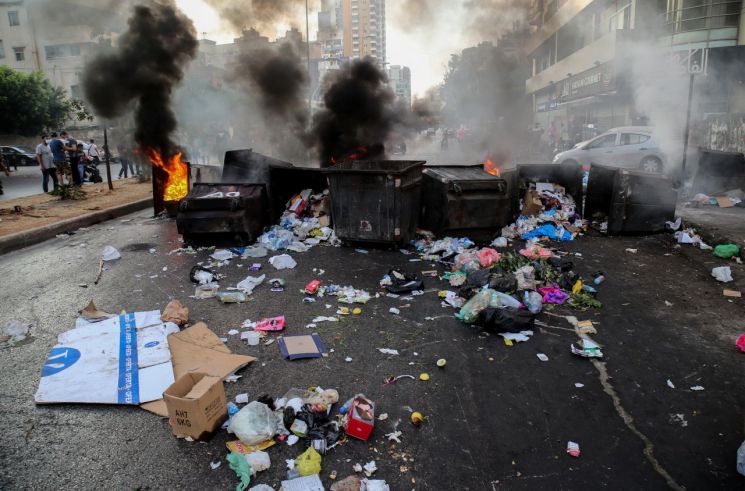 On the 15th (local time) in Beirut, Lebanon, shortly after the resignation of Prime Minister-designate Hariri, citizens held anti-government protests, and a trash bin on the street caught fire. [Image source=EPA Yonhap News]
Even after Hariri's resignation, no successor has been appointed, making a government vacuum inevitable for the time being.
Previously, Hariri, a prominent tycoon in Lebanon, served as prime minister from 2009 to 2011 and was re-elected as prime minister in December 2016. However, he resigned in 2019 following anti-government protests demanding reforms such as resolving unemployment and eradicating corruption.
In August last year, following the massive Beirut explosion disaster, the cabinet led by Prime Minister Hassan Diab resigned, taking responsibility for the incident.
Mustafa Adib, who was nominated as his successor, attempted to form a new government but gave up and stepped down after a month.
Subsequently, in October last year, President Aoun re-nominated Hariri as prime minister, but after a nine-month standoff over government formation, he ultimately declared his withdrawal.
Such prolonged political turmoil, combined with the aftermath of the Beirut explosion and the impact of COVID-19, has worsened Lebanon's economic crisis.
In particular, the value of the Lebanese pound continues to plummet endlessly.
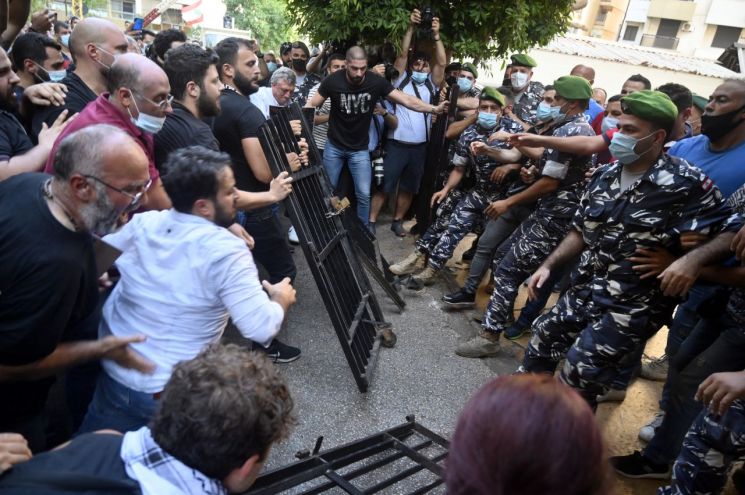 On the 13th (local time), bereaved families of the victims of last year's massive explosion disaster in Beirut, Lebanon, held a protest in front of the Lebanese Interior Minister's residence and clashed with the police.
 [Image source=EPA Yonhap News]
Lebanon has maintained a fixed exchange rate (1,507 pounds per dollar) since 1997, but recently, in the black market, the exchange rate has approached 21,000 pounds per dollar. The currency has effectively become worthless.
It is also reported that the currency value has plummeted by more than 90% just this year.
Additionally, food inflation has reached 400%, and due to fiscal shortages, the government no longer has the capacity to pay soldiers' salaries, putting the military at risk of collapse.
CNBC reported that this economic hardship is causing an 'exodus' phenomenon, with citizens leaving Lebanon.
Lebanon has long been criticized for chronic political corruption exacerbating its economic crisis.
Along with this, analyses suggest that Lebanon's unique power-sharing structure among religious groups has further aggravated political corruption.
Currently, Lebanon is home to 18 intertwined sects including Sunni and Shia Islam, Christian Maronites, and Greek Orthodox, with a unique power-sharing principle whereby the president is a Christian Maronite, the prime minister is a Sunni Muslim, and the speaker of parliament is a Shia Muslim.
This division of power has been criticized for causing corruption and inefficiency. It is also pointed out that this power-sharing structure has increased the possibility of political interference by foreign forces.
© The Asia Business Daily(www.asiae.co.kr). All rights reserved.



















