Inflation Concerns Capped
US Treasury Yields Fall Again Intraday to 1.29%
Concerns Over Soaring Housing Prices
Powell Says "The Challenge Is How to Respond to Inflation"
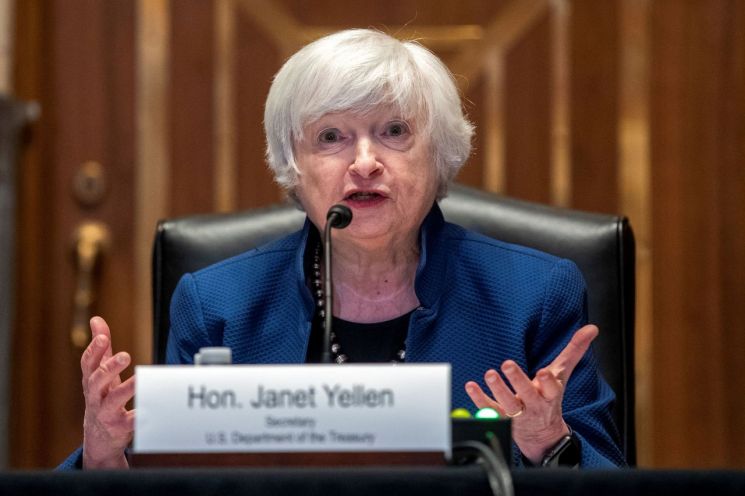
[Asia Economy New York=Correspondent Baek Jong-min] Janet Yellen, U.S. Treasury Secretary, said that the rise in inflation will continue for several months but will eventually stabilize, and that the market is assessing this situation through government bond yields.
Although Yellen, a former Chair of the U.S. Federal Reserve (Fed), does not have authority over monetary policy decisions, she appeared to support Fed Chair Jerome Powell’s congressional testimony, aiming to block concerns about inflation and arguments for interest rate hikes.
In an interview with CNBC on the 15th (local time), Secretary Yellen said, "Rapid inflation will continue for a few more months."
She added, "I wouldn’t say this is a one-month phenomenon, but I believe that in the medium term, inflation will decline and return to normal levels."
The U.S. Consumer Price Index (CPI) for June, released on the 13th, rose 5.4% compared to a year ago, marking the highest level in 13 years and increasing concerns about inflation and changes in monetary policy.
Using the recently declining U.S. Treasury yields as an example, Yellen said, "It appears that inflation expectations are well controlled in the medium term," and "The market sees that inflation is under control." She reiterated, "Inflation still needs to be watched carefully, but it will eventually be resolved."
Despite the ongoing rise in inflation, the U.S. 10-year Treasury yield fell by 0.055 percentage points that day to 1.301%. During the day, yields dropped as low as 1.292%, threatening the 1.3% level.
After entering the 1.2% range last week, U.S. Treasury yields rose to the 1.4% range immediately after the June CPI release this week, but following Fed Chair Jerome Powell’s strong denial of the possibility of monetary policy adjustments during his appearance before the House the previous day, yields returned to a downward trend.
Powell also appeared before the Senate that day and emphasized again, "Price increases are larger than we expected, but if inflation is temporary, responding to it would be inappropriate," adding, "The challenge we face is how to respond to this inflation."
Powell said, "If inflation lasts longer, we will need to reassess the risks," leaving room for the possibility of monetary policy changes.
Secretary Yellen also forecast that the U.S. government’s infrastructure investment plan would help economic recovery rather than stimulate inflation, but expressed concerns about rising housing prices.
Yellen said, "There are no risks in the housing market like those just before the 2008 financial crisis," but added, "There are worries about whether first-time homebuyers or low-income families can afford the sharply rising housing prices."
According to the S&P CoreLogic Case-Shiller Index, U.S. housing prices rose by 15% annually in April. Since this increase is larger than the 12.9% rise in March, concerns are widespread that housing prices may have risen further in June.
As the housing market remains strong, there have been opinions within the Fed that the purchase of mortgage-backed securities (MBS), which accounts for up to $40 billion out of the $120 billion monthly asset purchases, should be reduced first. However, Chair Powell drew a line, saying it is still far from meeting the conditions for tapering asset purchases.
© The Asia Business Daily(www.asiae.co.kr). All rights reserved.











