100 Days Since Mayor Oh Se-hoon's Inauguration: Foundations Laid for Oh Se-hoon’s Pledge Implementation... Amid Historic Surge in COVID-19 Cases, Emergency in Pandemic Control
'Seoul-Style Coexistence Quarantine' Accelerated, 'Self-Test Kit Introduction' Under Scrutiny... Political Deputy Mayor’s Statement Criticizing Government and Ruling Party Sparks Controversy
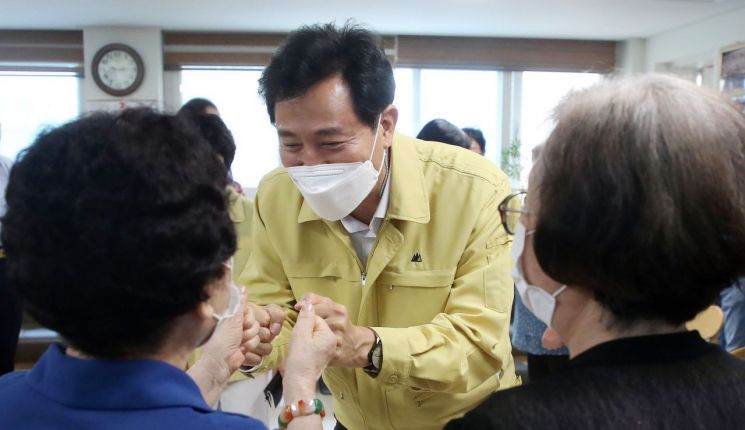
[Asia Economy Reporter Lim Cheol-young] Mayor Oh Se-hoon, who returned as the Mayor of Seoul after 10 years, has marked 100 days since his inauguration. Leading with the slogan "Skilled from Day One," Mayor Oh has refrained from political strife and focused on performance-driven actions to overcome the limitations of his term, which is just over a year. However, with the recent surge in new COVID-19 cases in Seoul reaching 500 to 600 daily, some analysts suggest that Oh Se-hoon's distinctive city administration is now facing a critical test as it seeks to differentiate itself from the central government.
During his 100 days in office, Mayor Oh has concentrated on initiatives such as the "Seoul-style Coexistence Quarantine," the introduction of "self-test kits," easing regulations on reconstruction and redevelopment, and support for single-person households. The biggest issue for Seoul citizens, the "real estate problem," has been addressed under the principle of "swift but cautious," laying the groundwork for Oh Se-hoon's real estate policies aimed at stabilizing prices and resolving supply issues. However, the stubbornly high housing prices remain a challenge that requires more proactive solutions.
Following a sharp rise in Seoul apartment prices after his inauguration, Mayor Oh announced a strict zero-tolerance policy against market disruption as his first real estate measure and designated four redevelopment and reconstruction areas?Apgujeong-dong, Yeouido-dong, Mok-dong, and Seongsu-dong?as land transaction permission zones in April. In May, he announced six major redevelopment deregulation measures, including the abolition of the residential maintenance index system, consideration of introducing public architectural planning, and easing regulations on general residential areas with seven-story buildings.
To establish comprehensive measures for guaranteed income and support for single-person households, which were election pledges, a separate organization was formed. The guaranteed income policy is a "regressive welfare" model that differs from basic income by compensating the income of households below the median income. The "Seoul Guaranteed Income Pilot Project Advisory Group," launched by Mayor Oh for the pilot project, is reportedly in the final stages of basic design. The Seoul Metropolitan Government plans to implement the pilot project within the year and expand it sequentially.
Following the guaranteed income initiative, efforts have accelerated on the single-person household policy, one of the major welfare pledges. Mayor Oh stated that Seoul's 1.3 million single-person households suffer from issues such as safety, illness, poverty, loneliness, and housing, and to prepare comprehensive and multidimensional support measures, a separate task force (TF) was formed in April and is currently operating. The TF is expected to be reorganized into a regular organization directly under the mayor called the "Single-Person Household Special Measures Promotion Team" by the 19th through organizational restructuring.
Efforts have also been made to minimize conflicts with the Seoul Metropolitan Council, where the Democratic Party holds 101 of 110 seats, and to maintain cooperation and administrative continuity by continuing projects such as the Gwanghwamun Plaza restructuring and full implementation of free kindergarten meals, which began under the previous mayor. On his first day at work, April 9, Mayor Oh visited the Seoul Metropolitan Council first to request cooperation for smooth city administration. He also lowered his stance by personally visiting standing committees to resolve issues raised by council members regarding organizational restructuring and supplementary budgets.
However, some key policies pushed forward rapidly have become burdensome. The "Seoul-style Coexistence Quarantine" and the introduction of "self-test kits" are representative cases. From the first week of his term, Mayor Oh sent the message that "the government's uniform quarantine measures will not work," accelerating differentiated business hours by industry and the proactive introduction of self-test kits. Small business associations welcomed the policy direction, and the policy seemed to be yielding results.
The situation changed rapidly. Coincidentally, the number of new COVID-19 cases in Seoul, which had seemed to be under stable control, began to surge from late June due to relaxed quarantine measures, reaching record highs on July 6 and 14 since the outbreak. The Seoul-style coexistence quarantine and self-test kit introduction, which started to differentiate from the central government's quarantine, were effectively halted during the pilot project. Mayor Oh shifted tactics by expanding COVID-19 testing capacity, reducing nighttime public transportation operations by 20%, and issuing administrative orders banning outdoor nighttime drinking, but he found himself in a difficult position as the "Seoul City quarantine responsibility theory" spread.
To make matters worse, Kim Do-sik, Deputy Mayor for Political Affairs known as the close aide of Ahn Cheol-soo, leader of the People’s Party, issued a strongly critical statement against the Blue House and central government on the 14th, putting public opinion under scrutiny. Although Deputy Mayor Kim later tried to downplay it as a personal opinion, the off-stage disputes surrounding Mayor Oh continue. Additionally, allegations have been raised that the fund usage procedures were ignored during the pilot project for the rapid introduction of self-diagnosis kits.
At 100 days in office, while preparations for the "Oh Se-hoon-style administration" have been somewhat completed, the worst quarantine situation has brought a new test. Mayor Oh has also responded through his SNS, stating that the theory blaming Seoul City for quarantine failures is being distorted as fake news and is problematic.
Through his Facebook, Mayor Oh emphasized, "Dividing each other and blaming others does not help quarantine efforts," adding, "We did not implement any quarantine easing measures without agreement with the Central Disaster and Safety Countermeasure Headquarters, and the tailored quarantine by industry was only implemented restrictively in some indoor sports facilities. Going forward, we will do our utmost together with the Central Disaster and Safety Countermeasure Headquarters."
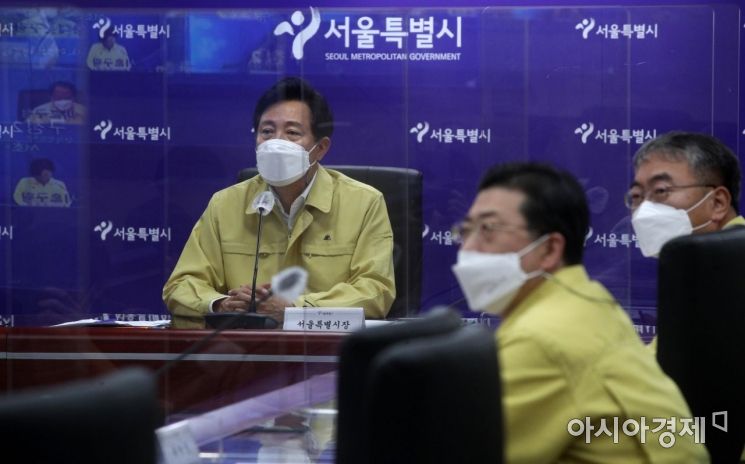 Seoul Mayor Oh Se-hoon is presiding over an emergency video conference meeting on urgent issues between Seoul City and its 25 autonomous districts at Seoul City Hall on the 8th. Photo by Hyunmin Kim kimhyun81@
© The Asia Business Daily(www.asiae.co.kr). All rights reserved.
![Clutching a Stolen Dior Bag, Saying "I Hate Being Poor but Real"... The Grotesque Con of a "Human Knockoff" [Slate]](https://cwcontent.asiae.co.kr/asiaresize/183/2026021902243444107_1771435474.jpg)

















