Number of Employees Decreased by 1,145 in One Year
Acceleration of Non-Face-to-Face Digital Transformation
Business Deterioration...Concerns Over Spread of Voluntary Retirement
[Asia Economy Reporter Oh Hyung-gil] In the insurance industry, often referred to as the "human-paper (人紙) industry" because it is said to be made up only of people and paper, people are leaving. With the expansion of non-face-to-face digital transformation due to the impact of COVID-19, new hiring has decreased, and personnel restructuring accompanied by organizational reorganization triggered by the "separation of manufacturing and sales" is expected to accelerate this trend even further.
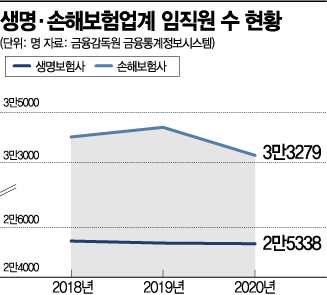
According to the Financial Supervisory Service's Financial Statistics Information System on the 15th, the number of employees at insurance companies was 58,617 as of the end of last year, down 1,145 from 59,762 at the end of 2019.
The number of employees at life insurance companies was 25,338, a decrease of 24 compared to the previous year, while the number of employees at non-life insurance companies decreased significantly by 1,121 to 33,279. In particular, non-life insurers had increased their workforce significantly over the past few years but turned to a decline starting last year. The number of non-life insurance employees was 32,414 in 2017, rising to 34,015 in 2018 and 34,400 in 2019.
The number of employees has continued to decline this year as well. Excluding executives, Samsung Fire & Marine Insurance had 5,698 employees, down 467 from 6,165 in the same period last year. Regular employees numbered 5,613 and non-regular employees 85, decreasing by 27 and 440 respectively compared to the same period last year. Samsung Fire & Marine Insurance also saw a sharp drop in total hires, including experienced hires, from 174 in 2019 to 134 last year.
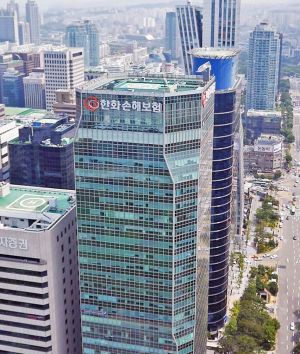
Hanwha General Insurance's workforce decreased by 279 from 3,295 in the first quarter of last year to 3,016 this year, while Hyundai Marine & Fire Insurance adjusted its staff from 4,172 to 4,071, and KB Insurance reduced its employees from 3,200 to 3,136.
The reduction in insurance industry employees was largely due to recent restructuring. Hyundai Marine & Fire Insurance, Hanwha General Insurance, AXA General Insurance, and Lotte General Insurance conducted voluntary retirements last year. Life insurer Prudential Life also carried out voluntary retirement in December last year. This year, KB Insurance conducted a voluntary retirement program involving about 100 employees for the first time in two years last month.
Concerns are rising that if the prolonged COVID-19 pandemic worsens the insurance business environment and increases pressure to cut costs, a relay of voluntary retirements may continue. The rapid spread of digital transformation and the emergence of fintech companies in the financial sector, which require changes in business structure, are also factors intensifying personnel restructuring efforts. Internally, insurance companies are continuously reducing the need for workforce expansion by adopting IT technologies such as artificial intelligence (AI).
Job shifts to big tech companies entering the insurance sector are also expected to accelerate. Kakao Pay, which has received a preliminary license for digital non-life insurance, is currently recruiting to expand its insurance-related workforce.
An industry insider said, "Younger employees increasingly prefer to leverage their expertise to become independent early as corporate agents (GA) or loss adjusters rather than being tied to one company," adding, "As digital transformation progresses, companies will inevitably continue to reduce personnel to cut costs."
© The Asia Business Daily(www.asiae.co.kr). All rights reserved.


















