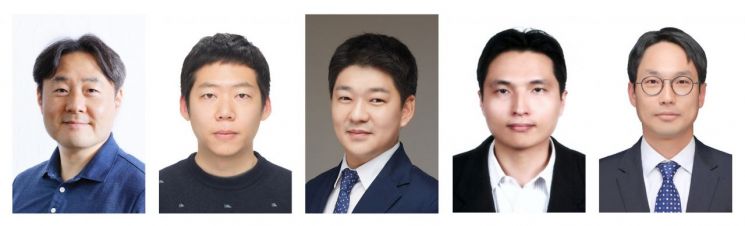
 Professors selected for the 2021 Samsung Future Technology Development Program designated theme research support project. Professor Hwang Do-sik of Yonsei University (from left), Professor Song Yong-su of Seoul National University, Professor Kim Min-gu of Inha University, Professor Choi Soo-seok of POSTECH, Professor Jung Kwon-beom of Dongguk University
 [Photo by Samsung Electronics]
[Asia Economy Reporter Kim Heung-soon] On the 15th, Samsung Electronics announced that it will provide a total of 15.21 billion KRW in research funding for 12 designated theme research support projects under the 'Samsung Future Technology Fostering Project' in 2021.
This year, 12 projects were selected across six fields for the designated theme research support projects: ▲Advanced Artificial Intelligence (AI) ▲Next-generation Cryptographic Systems ▲B (Beyond) 5G & 6G ▲Robotics ▲Next-generation Displays ▲Semiconductor Devices and Processes.
Among these, Next-generation Cryptographic Systems and Advanced AI were newly selected as designated themes. Samsung Electronics selects future promising science and technology fields as designated themes by discussing with scholars and experts in various scientific and technological fields about the national need for technology development and mid- to long-term technology development directions.
Newly Selected Fields: Advanced AI and Next-generation Cryptographic Systems
In the Advanced AI field, two projects were selected, including Professor Hwang Do-sik of Yonsei University's Department of Electrical and Electronic Engineering's project titled 'Recurrent Reasoning-type Artificial Intelligence - Self Question and Answer-based Automatic Medical Diagnosis Technology.'
Professor Hwang plans to develop a deep learning model that repeatedly creates questions and answers by AI itself, comprehensively utilizing various data such as CT, MRI, X-rays, and ultrasound used in disease diagnosis.
Samsung Electronics stated, "If this research, which aims to precisely mimic the medical examination process of specialists, is applied in actual medical settings, it is expected to improve the accuracy of disease diagnosis."
In the Next-generation Cryptographic Systems field, Professor Song Yong-soo of Seoul National University's Department of Computer Engineering's project titled 'Development of Core Technology for Multi-party Approximate Computation Cryptography' was selected. This technology enables data analysis while maintaining the confidentiality of sensitive data stored in the cloud.
In the Robotics field, Professor Kim Min-gu of Inha University's Department of Information and Communication Engineering's project titled 'Vision-Tactile Recognition Technology for Manipulating Deformable Objects with Dynamic Center of Mass at Human Level' was selected. This project aims to develop technology that enables robots to handle objects at a human level by integrating visual and tactile information.
In the Next-generation Display field, four projects were selected, including Professor Choi Soo-seok of POSTECH's Department of Electrical and Computer Engineering's 'Research on Pixel-Arrayed Chiral Laser Based on Wavelength-Tunable Perovskite Nanocrystals,' a light source technology for hologram implementation, and Professor Jung Kwon-beom of Dongguk University's Department of Physics and Semiconductor Science's 'Development of Defect Imaging Technology for Inline Monitoring of Transistor Devices for Ultra-high Resolution PPI Displays.'
Samsung Future Technology Fostering Project Invests 1.5 Trillion KRW
The Samsung Future Technology Fostering Project is a public research support project implemented by Samsung Electronics since 2013 with an investment of 1.5 trillion KRW, aiming to foster and support science and technology that will lead Korea's future.
Every year, projects to be supported are selected in the fields of basic science, materials, and ICT during the first and second halves of the year, and through the once-a-year 'Designated Theme Project Call,' future technology fields necessary for the nation are designated and supported. Since 2014, designated theme projects have been selected, and up to this year, a total of 103 research projects have received 105.93 billion KRW in funding.
This project is characterized by allowing researchers to conduct challenging research without being held accountable if goals are not achieved, and by utilizing failure causes as intellectual assets.
Various programs are also operated, such as the 'Annual Forum,' where principal investigators explain research outcomes and key issues and gain new ideas through discussions with attending researchers; R&D exchange meetings to enhance industrial utilization of research results; and intellectual property (IP) mentoring supporting the filing of highly useful patents.
Including the research projects announced this time, Samsung Electronics has so far allocated 886.5 billion KRW in research funding for a total of 682 research projects: 229 in basic science, 224 in materials, and 229 in ICT fields.
© The Asia Business Daily(www.asiae.co.kr). All rights reserved.

















