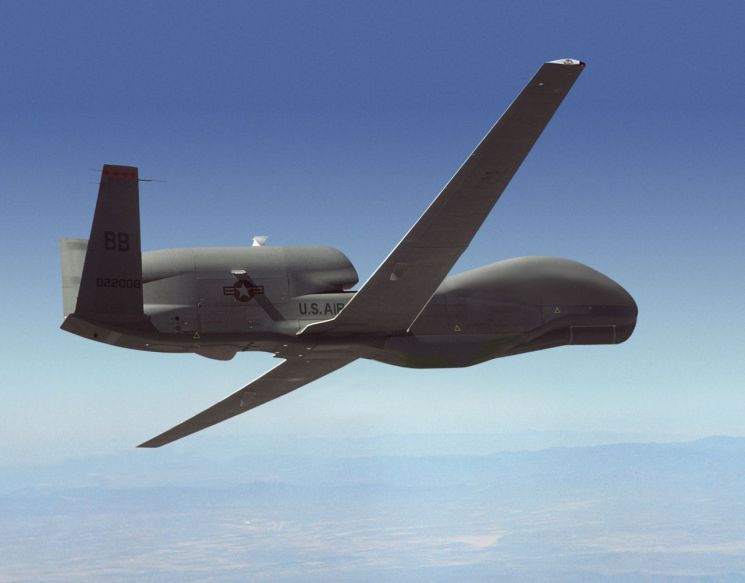
[Asia Economy Yang Nak-gyu, Military Specialist Reporter] Northrop Grumman's Global Hawk unmanned reconnaissance aircraft is set for a performance upgrade.
On the 14th, Northrop Grumman announced, "Together with the U.S. Air Force, we plan to upgrade the RQ-4 Global Hawk's software, enhance cybersecurity, and operate a man-machine interface equipped with artificial intelligence."
Northrop Grumman named this performance upgrade task "ad-hoc tasking" and stated that it will configure a new ground station command and control system to reduce transmission and reception times and significantly increase image resolution. In particular, the Global Hawk will be equipped with autonomous functions to observe enemy training, troop deployments, and armed activities for up to 40 hours over enemy territory, comparing and analyzing the data collected by the military so far.
Meanwhile, our military also operates the Global Hawk. Our military's Global Hawk is an intelligence satellite-grade unmanned reconnaissance aircraft capable of identifying objects as small as 0.3 meters on the ground from an altitude of 20 km using special high-performance radar and infrared detection equipment. It can conduct operational flights lasting 38 to 42 hours once airborne. Its operational radius reaches 3,000 km, allowing surveillance beyond the Korean Peninsula. The Global Hawk has a wingspan of 35.4 meters, a length of 14.5 meters, a height of 4.6 meters, a maximum cruising speed of 250 km/h, and a weight of 11,600 kg.
With the operation of this reconnaissance aircraft, the military authorities have become capable of independently collecting video intelligence within North Korea, which had previously been absolutely dependent on the United States. It is equipped with special high-performance radar that can monitor the ground during day and night as well as in adverse weather conditions. Mobile launchers (TELs) carrying various missiles and moving on the ground are detected by the Global Hawk's surveillance network. The Global Hawk is operated by the Air Force's 39th Reconnaissance Wing, and the collected information is sent to the Air Intelligence Group.
Some argue that although the military obtains North Korean military information through civilian satellites or high-altitude unmanned reconnaissance aircraft like the Global Hawk, to accurately detect signs of provocations in advance, the military must launch reconnaissance satellites. Our military operates reconnaissance assets mainly based on aerial platforms to acquire images, but aerial assets have limited sensor detection ranges, restricting surveillance and reconnaissance of the entire enemy territory.
The military began developing reconnaissance satellites in 2018. The satellites currently under development are expected to be deployed sequentially starting in 2023. It is anticipated that it will take about 10 years or more from the initial planning to full operational deployment.
© The Asia Business Daily(www.asiae.co.kr). All rights reserved.

















