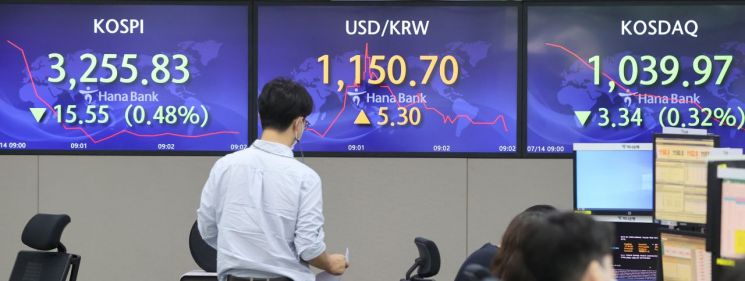
[Asia Economy Reporter Eunbyeol Kim] The won-dollar exchange rate surpassed 1,150 won, hitting a year-to-date high. This was due to U.S. inflation indicators significantly exceeding market expectations, reviving inflation concerns and strengthening the dollar.
As inflation concerns resurfaced in the market, interpretations emerged that the U.S. Federal Reserve (Fed) might initiate early tapering (reduction of asset purchases), leading to a stronger dollar. Meanwhile, domestically, the number of new COVID-19 cases exceeded 1,600, setting another record high, which also contributed to risk-averse sentiment.
On the 14th, the won-dollar exchange rate started at 1,150.7 won, up 5.3 won from the previous day, and showed a gradual upward trend, trading around the 1,151 won level. This was influenced by the U.S. June Consumer Price Index (CPI) released on the 13th (local time), which rose 5.4% year-on-year, marking the highest increase in 13 years. The main factors driving inflation were soaring international oil and commodity prices, revived automobile (used cars, trucks, etc.) and travel industries, and increased airfare.
Following the U.S. CPI announcement, the dollar index rose to around 92.8, reaching its highest level since April. The interpretation was that if inflation concerns grow, the Fed might start tapering early, withdrawing dollars from the market, which would increase the dollar's value.
Along with inflation concerns and the possibility of early tapering, U.S. Treasury yields also rose. The 10-year U.S. Treasury yield slightly increased to 1.418% from the previous closing price of 1.415%. Coupled with weak demand in the 30-year auction, the 30-year yield rose to 2.047%, entering the 2% range.
The 10-year Korean government bond yield was trading at 2.039%, up 0.20% as of 10:16 a.m. Recently, bond yields had been declining, but they appear to have rebounded amid renewed inflation concerns.
© The Asia Business Daily(www.asiae.co.kr). All rights reserved.
![Clutching a Stolen Dior Bag, Saying "I Hate Being Poor but Real"... The Grotesque Con of a "Human Knockoff" [Slate]](https://cwcontent.asiae.co.kr/asiaresize/183/2026021902243444107_1771435474.jpg)











