Investment of 285 Billion KRW by 2023
Capable of Processing up to 2.75 Million Boxes per Day
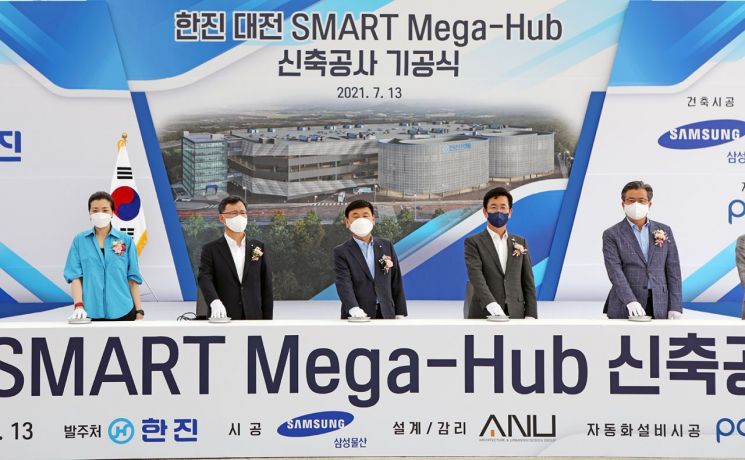 (From left) Cho Hyun-min, Vice President of Future Growth Strategy and Marketing at Hanjin; Ryu Kyung-pyo, CEO of Management Control at Hanjin; Noh Sam-seok, CEO of Business Operations at Hanjin; Heo Tae-jung, Mayor of Daejeon; and Jeong Yong-rae, Mayor of Yuseong District, are conducting the groundbreaking ceremony for the Daejeon Smart Mega Hub Terminal at the Daejeon Integrated Logistics Complex in Yuseong-gu, Daejeon on the 13th.
[Asia Economy Reporter Dongwoo Lee] Hanjin announced that it held a groundbreaking ceremony on the 13th to build the Daejeon Smart Mega Hub Terminal, aiming to achieve a 20% market share in the parcel delivery market by 2023.
The event, held at the Daejeon Comprehensive Logistics Complex in Yuseong-gu, Daejeon, was attended by key figures including Hanjin's CEO of Business Division Nosam Seok, CEO of Management Division Ryu Kyung-pyo, Vice President in charge of Future Growth Strategy and Marketing Cho Hyun-min, and Daejeon Mayor Heo Tae-jung.
Hanjin decided to invest to strengthen the core capabilities of the parcel delivery and logistics industry in the post-COVID-19 era and secure new growth engines, signing an investment and support business agreement with Daejeon City in June last year.
Hanjin plans to invest 285 billion KRW by 2023 to build a super-large-scale logistics center with a total floor area of 149,110 m², equivalent to 20 soccer fields, on a 59,541 m² site within the Daejeon Comprehensive Logistics Complex.
The company currently owns 11 hub terminals nationwide, including hubs located in Daejeon, Jangji-dong, Songpa-gu, Seoul, and Gasan-dong, Geumcheon-gu. Once the Daejeon Smart Mega Hub Terminal is completed, the hub-and-spoke delivery system, which consolidates parcel volumes at the mega hub terminal for processing, will be further strengthened, significantly improving operational efficiency by reducing costs and minimizing the number of transit points.
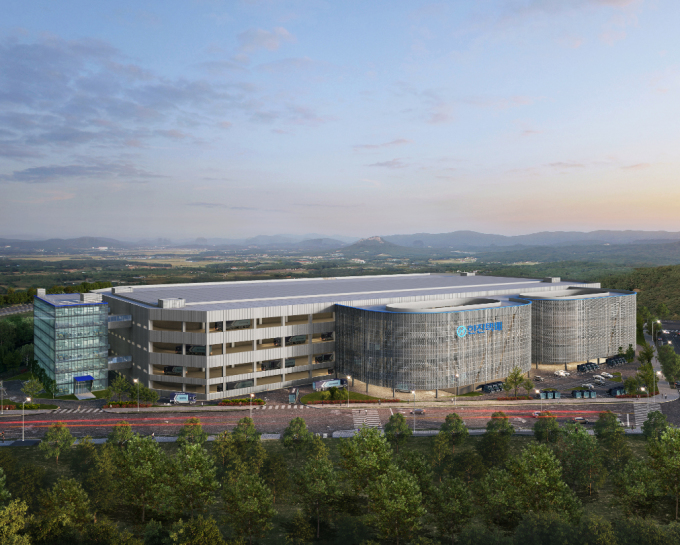
The Daejeon Smart Mega Hub Terminal can simultaneously handle loading and unloading operations for 568 cargo trucks. It has introduced a next-generation parcel operation platform that integrates AI solutions for automatic cargo identification, sorting plans, equipment control, and operational status. It is built as a smart logistics center equipped with cutting-edge facilities such as 3D automatic scanners that read product barcodes via cameras and automatic parcel sorters, with plans to expand into fulfillment services in the future.
It can process 1.2 million parcel boxes daily, and the total daily processing capacity for Hanjin parcels will reach 2.75 million boxes. More than 1,200 personnel will be employed for terminal management and operations, contributing to local job creation.
To respond stably to the continuous increase in parcel demand and improve working conditions, Hanjin plans to establish the East Seoul Hub Terminal as a mega hub terminal, promote the construction and expansion of parcel terminals in key regions nationwide, and invest approximately 510 billion KRW over the next five years to introduce automation facilities.
A Hanjin official said, "As untact business rapidly grows, the parcel delivery and logistics industry has now become a core future industry of South Korea. Together with the innovative city of Daejeon, the Daejeon Smart Mega Hub Terminal, which will become a core competency of Hanjin leading Korea's logistics history, will drive regional economic revitalization as a new growth engine and practice ESG management where companies and cities grow together."
© The Asia Business Daily(www.asiae.co.kr). All rights reserved.


















