Research Team Led by Professor Park Hong-gyu of Korea University and Professor Kibsha of Australian National University Collaborate
"Free from Energy Loss and Heat Generation Issues... Will Accelerate Commercialization of Optical Devices"
[Asia Economy Reporter Kim Bong-su] An ultra-microscopic nanolaser that operates with ten million times less energy than before and can strongly focus light in a small space has been developed. It is attracting attention as it can be used to manufacture components for mobile devices such as smartphones and computers that are free from energy loss and heat generation issues and operate at high speeds.
The National Research Foundation of Korea announced on the 13th that Professor Park Hong-gyu's research team at Korea University, in collaboration with Professor Kibsha from the Australian National University, discovered a new resonance phenomenon and designed an ultra-low-power nanolaser that can oscillate with ten million times less energy than existing lasers.
As lasers become miniaturized, the resonator component also shrinks, and the performance of the laser depends on how well the small resonator can concentrate light. A method to trap light using the charge of an energy state called Bound State in the Continuum (BIC), which does not interact with the surrounding space, is being considered to strongly amplify light when desired. However, as the resonator becomes smaller, it cannot effectively trap light, rendering the physical phenomenon using this energy state ineffective.
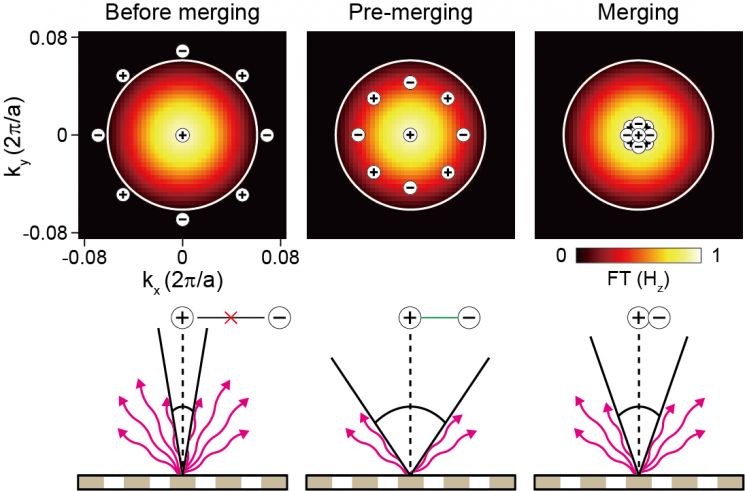
The research team devised a ‘Super BIC’ that simultaneously couples multiple BICs instead of the existing methods, which have strict operating conditions and limitations in miniaturization. They merged two charges that do not interact with the surroundings into one point. This blocks the possibility of light escaping and, through merging, prevents light leakage even at small sizes. By creating a square lattice structure on a substrate and finely adjusting the lattice hole spacing to the nanometer level, they successfully experimentally implemented the ‘Super BIC’ laser. When the spacing was 574 nm, different BICs merged, forming the ‘Super BIC’ laser. This proposed the method of BIC merging as a new paradigm in laser device design.
The laser made in this way lowered the threshold energy required for oscillation by up to ten million times compared to existing nanolasers. This means power consumption can be greatly reduced. Even if the structure shrinks or defects occur, the merging is unaffected, so it is expected to be used as a flexible light confinement method.
The research team plans to continue follow-up studies using flexible devices that can adjust lattice spacing more flexibly and precisely.
The results of this study were published on the 5th in the international academic journal Nature Communications.
© The Asia Business Daily(www.asiae.co.kr). All rights reserved.
![User Who Sold Erroneously Deposited Bitcoins to Repay Debt and Fund Entertainment... What Did the Supreme Court Decide in 2021? [Legal Issue Check]](https://cwcontent.asiae.co.kr/asiaresize/183/2026020910431234020_1770601391.png)















