Korea Road Traffic Authority Conducts Traffic Environment Improvement Project
Speed Increases and Environmental Costs Decrease
Traffic Safety Improves by 17%
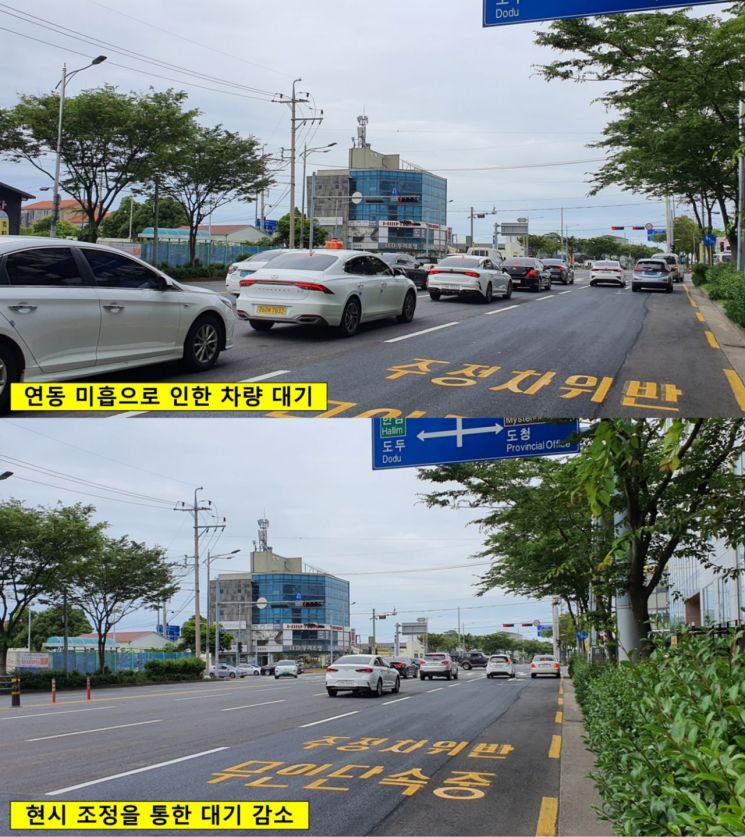 Comparison of signal operation before and after improvement at a major residential area intersection (Jeju Yetgol Toseong 4-ga). [Photo by Road Traffic Authority]
[Asia Economy Reporter Lee Gwan-joo] The Korea Road Traffic Authority has reported that improving the signal systems and traffic safety facilities at major intersections nationwide has generated economic benefits exceeding 120 billion KRW annually. This figure reflects reductions in travel time and environmental cost savings.
The Korea Road Traffic Authority announced on the 13th that it conducted traffic environment improvement projects at 41 major intersections in residential areas across the country during the first half of this year.
This project was carried out in collaboration with related organizations such as the police and local governments, targeting major intersections in residential areas including locations with frequent pedestrian accidents involving the elderly and children, as well as commercial and apartment-dense areas, where congestion and traffic accidents frequently occur during specific times. The project involved improving signal systems and traffic safety facilities at these key intersections.
As a result, vehicle speeds around the intersections improved by 12.1% (from 21.5 km/h to 24.1 km/h), and delay times decreased by 19.0% (from 99.7 seconds/km to 80.8 seconds/km). When converted into monetary terms, this translates to an annual saving of approximately 26.4 billion KRW in vehicle operating costs. Including travel time costs and environmental cost savings, the total annual economic benefit is estimated to be about 122.2 billion KRW, the authority explained.
Prior to this, the authority analyzed the signal operation systems of intersections using traffic analysis programs. Intersections with irrationally operated signal cycles and coordination systems were prioritized for improvement, and comprehensive improvement plans including facility upgrades and geometric changes to intersections were established. Analyzing these plans with the traffic safety simulation (SSAM) predicted an improvement in traffic safety by approximately 17.4%.
Lee Joo-min, the director of the authority, stated, "In the second half of this year, we will establish highly effective improvement measures at 39 major intersections in residential areas that the public can directly feel. We will strive to become a leading institution in traffic safety by enhancing vehicle flow and reducing and preventing traffic accidents."
© The Asia Business Daily(www.asiae.co.kr). All rights reserved.

















