Non-Capital Region Accounts for 27% of New Cases
Capital Area Living Treatment Centers Exceed 80% Utilization Rate
One-Week Critical Period Expected Before Phase 4 Effects Become Visible
[Asia Economy Reporter Kim Ji-hee] The record high number of new COVID-19 cases on Sunday was influenced not only by the surge in cases in the metropolitan area but also by a rapid increase in cases in non-metropolitan regions. The feared 'nationwide large-scale spread' has become a reality. Until last week, the proportion of cases in non-metropolitan areas was less than 20%, but on the 12th, it rose to 27%. This week is expected to be the biggest turning point of the '4th wave.' While the metropolitan area is under the highest level 4 social distancing measures, many non-metropolitan areas remain at levels 1 to 2, which could create gaps in quarantine measures. There are also growing concerns that beds in residential treatment centers for confirmed patients will soon reach full capacity.
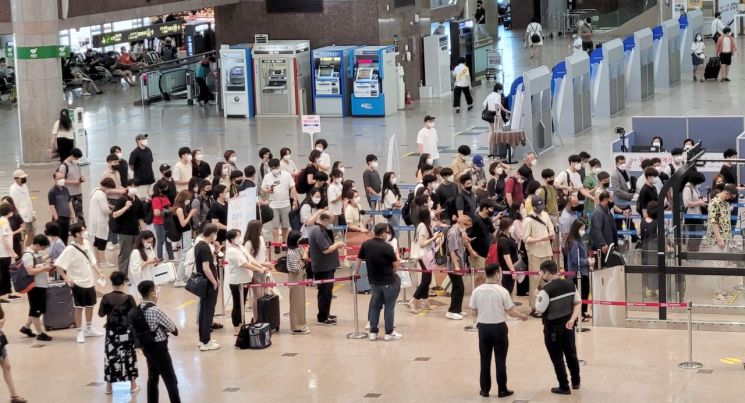
◆Emergency in the Spread in Non-Metropolitan Areas= According to the Central Disease Control Headquarters, the daily number of COVID-19 confirmed cases at midnight was 1,100, which decreased for two consecutive days due to the weekend effect after peaking at 1,378 on the 10th. However, despite the weekend effect, the number exceeded 1,000 for two consecutive days, setting a record high for Saturdays and Sundays. Unlike the metropolitan area, where level 4 social distancing tightened quarantine measures, the anxiety in non-metropolitan areas, which are still at levels 1 to 2, is greater. Non-metropolitan cases totaled 288, accounting for 27.1% of all locally transmitted cases. The proportion in non-metropolitan areas has steadily increased from 22.1% on the 9th and 24.7% on the 11th to the current level.
The quarantine authorities recently pointed to Daejeon, Chungnam, Busan, Gyeongnam, and Jeju as particularly concerning non-metropolitan regions. On this day, Busan and Chungnam each recorded 43 cases, the highest number of new confirmed cases among non-metropolitan areas. Other regions reported 40 in Gyeongnam, 37 in Daegu, 25 in Daejeon, and 7 in Jeju. Son Young-rae, head of the Social Strategy Division at the Central Accident Response Headquarters, explained, "The increase in cases is due to various factors such as the spread through entertainment facilities and workplaces," adding, "Local governments are adjusting social distancing levels and strengthening quarantine measures according to the characteristics of the spread in each region."
Daejeon and Busan were elevated to level 2 from the 8th, and Jeju decided to apply level 2 for two weeks starting this day. Busan and Jeju, in particular, are expected to see visits from metropolitan residents during the summer vacation season, increasing the possibility of spread. Regions currently maintaining level 1, such as Daegu, Ulsan, Gwangju, Sejong, Chungbuk, Jeonbuk, Jeonnam, Gyeongbuk, Gyeongnam, and Gangwon, are also at risk of experiencing a balloon effect.
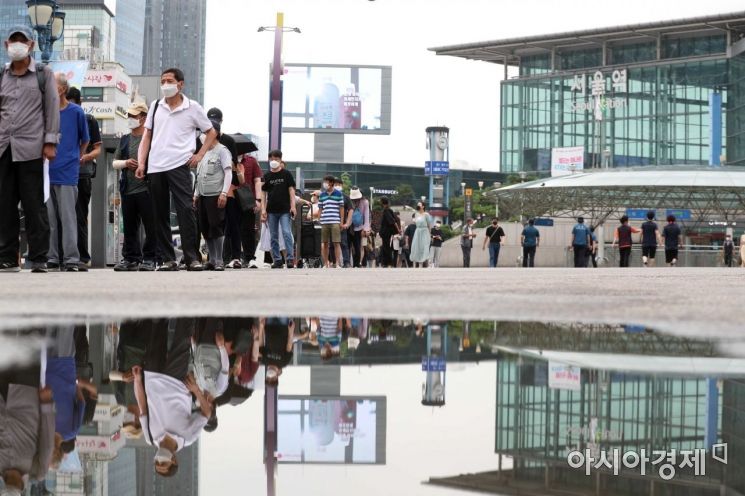 On the first day of the Level 4 social distancing measures in the Seoul metropolitan area to prevent the spread of COVID-19, citizens are waiting for testing at a temporary screening clinic set up at Seoul Station Plaza on the 12th. Photo by Moon Honam munonam@
◆‘Home Treatment’ Option Due to Bed Shortage= As confirmed cases surge, securing beds in residential treatment centers for asymptomatic or mild COVID-19 patients has become urgent. In the metropolitan area, where the outbreak is severe, the occupancy rate has already exceeded 80%, and if the spread continues mainly among people in their 20s and 30s, a shortage of beds is likely soon. Authorities are mobilizing centers in other regions and have even introduced the home treatment option for single-person households.
As of the previous day, the occupancy rate of 41 residential treatment centers nationwide was 73.3%. This is an increase of 2.5% from 70.8% on the 10th in just one day. Among 27 residential treatment centers operated by local governments in Seoul, Gyeonggi, and Incheon, 4,143 patients were admitted out of a capacity of 5,024, resulting in an occupancy rate of 82.5%. Even when combining the six centers (capacity 1,760, admitted 996) operated by the Central Disaster and Safety Countermeasures Headquarters in the metropolitan area, only about 1,700 new admissions are possible. Two centers in Incheon have an occupancy rate exceeding 90%, leaving fewer than 40 available beds, and eight centers in Gyeonggi have an occupancy rate of 87.4%.
It is already known that some metropolitan patients are being transferred to residential treatment centers in neighboring regions. For now, authorities plan to open more than 5,000 additional beds within two weeks. Professor Jung Jae-hoon of the Department of Preventive Medicine at Gachon University College of Medicine said, "Regardless of the necessity of home treatment, there needs to be a shift in public consensus and awareness of the quarantine paradigm."
© The Asia Business Daily(www.asiae.co.kr). All rights reserved.
![Clutching a Stolen Dior Bag, Saying "I Hate Being Poor but Real"... The Grotesque Con of a "Human Knockoff" [Slate]](https://cwcontent.asiae.co.kr/asiaresize/183/2026021902243444107_1771435474.jpg)

















