[Asia Economy Reporter Su-yeon Woo] Due to the prolonged COVID-19 pandemic, 8 out of 10 self-employed business owners in neighborhood commercial districts experienced a decline in sales in the first half of this year. In terms of amount, sales dropped by an average of over 21%, raising concerns that self-employed individuals are being pushed into a dead end.
On the 12th, the Korea Economic Research Institute commissioned the market research firm Monoresearch to conduct the "2021 First Half Neighborhood Commercial District Status and Second Half Outlook Survey" targeting self-employed business owners in neighborhood commercial districts (521 respondents). As a result, 78.5% of respondents answered that their sales in the first half of this year decreased compared to the first half of last year. In terms of amount, it was analyzed that sales decreased by an average of 21.8%.
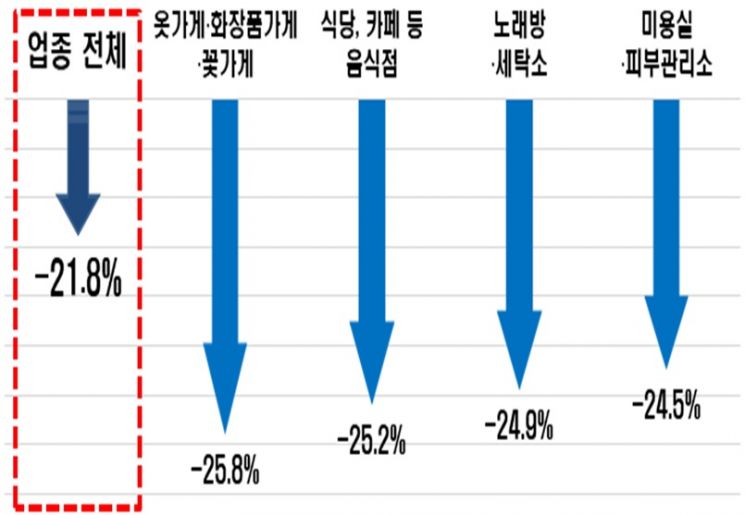
By industry, the sectors with the largest sales decline were clothing stores, cosmetics, and flower shops (25.8%), restaurants and cafes (25.2%), other businesses such as karaoke rooms and laundromats (24.9%), beauty salons and skin care (24.5%), and grocery retail stores such as supermarkets, convenience stores, and butcher shops. The most frequently cited reason for the sales decline was the worsening economy of neighborhood commercial districts due to the prolonged COVID-19 pandemic (58.2%), followed by intensified competition among the same industries within the same commercial district (16.2%), and the activation of competing commercial districts causing stagnation in the respective district (15.7%).
Regarding net profit, a practical profitability indicator, 73.5% of self-employed business owners in neighborhood commercial districts responded that their net profit decreased compared to the previous year in the first half of this year. In terms of amount, net profit decreased by an average of 17.7%. The causes of net profit decline were cited as sales decrease (56.6%), rise in raw material costs (13.6%), increase in labor costs (13.0%), increase in utility bills (7.2%), and increase in rent (6.7%).
The operating costs that burden self-employed business owners the most were rent (41.7%), labor costs (31.5%), raw material costs (12.7%), taxes (10.6%), and public utility fees such as electricity and water (2.7%). Among them, self-employed business owners without employees cited rent (50.4%) as the biggest burden, while those with employees cited labor costs (43.4%) as the greatest burden.
The worsening economy of neighborhood commercial districts also negatively affected employment. 33.6% of self-employed respondents answered that the number of employees decreased compared to the first half of last year, 62.9% said there was no change, and only 3.5% responded that the number of employees increased.
Self-employed business owners forecast a bleak outlook for the neighborhood commercial district economy in the second half of this year. Among the respondents, a majority of 65.3% expected sales in the second half of this year to decrease compared to the previous year, with an average expected decrease of 11.7% in terms of amount.
To revitalize the neighborhood commercial district economy, self-employed business owners responded that herd immunity through vaccination and easing of social distancing (35.2%), alleviation of labor cost burdens such as refraining from minimum wage increases (23.7%), reduction of public utility fees such as electricity and water charges (16.5%), activation of new startups through subsidies or financial support (15.5%), and business consulting support for neighborhood commercial district businesses (8.3%) are necessary.
Regarding the self-employed loss compensation system, 42.8%?a majority?responded that legislation is necessary to compensate for damages caused by national policies such as social distancing. Opinions were divided as follows: 31.3% said it is more necessary to alleviate burdens such as taxes, public utility fees, and labor costs than loss compensation; 22.1% said loss compensation is necessary but mandatory legislation is unnecessary; and 3.3% said loss compensation is unnecessary.
Choo Kwang-ho, Director of Economic Policy at the Korea Economic Research Institute, advised, "The government should prioritize the rapid formation of herd immunity and easing of social distancing, while simultaneously implementing policies to reduce the burdens on neighborhood commercial districts, such as refraining from minimum wage increases and providing discounts and support for public utility fees."
© The Asia Business Daily(www.asiae.co.kr). All rights reserved.
![From Hostess to Organ Seller to High Society... The Grotesque Scam of a "Human Counterfeit" Shaking the Korean Psyche [Slate]](https://cwcontent.asiae.co.kr/asiaresize/183/2026021902243444107_1771435474.jpg)
















