Research Service on Carbon Border Adjustment Response Strategies for the Steel Industry
[Asia Economy Reporter Kim Eun-byeol] The government has recognized that the Carbon Border Adjustment Mechanism (CBAM) being promoted by the European Union (EU) will significantly impact South Korea's steel industry and has begun preparing countermeasures.
According to industry sources on the 11th, the Ministry of Trade, Industry and Energy recently announced a research project titled "Global Carbon Border Adjustment Response Strategy and Competitiveness Enhancement Plan for the Steel Industry." The ministry stated, "The carbon border adjustment mechanism is expected to act as a new trade barrier, greatly affecting our export-dependent industries overall," adding, "In particular, if not properly prepared, it could seriously hinder the export competitiveness of our steel industry, which is the largest carbon emitter among industrial sectors."
The carbon border adjustment mechanism, also known as the "carbon border tax," is a system that imposes costs on products imported into the EU that are produced in countries with higher carbon emissions than the EU. The EU is scheduled to release the draft of the system on the 14th of this month and is expected to gradually implement it from 2023 on high carbon-emitting items such as steel, aluminum, and cement.
The European Commission plans to announce the legislative package "Fit for 55," aimed at reducing Europe's greenhouse gas emissions by 55% by 2030. The CBAM bill will also be disclosed at that time. According to the draft released earlier this month, the EU is considering applying CBAM primarily from 2023 to high carbon-emitting products such as electricity, cement, fertilizer, steel, and aluminum. After a three-year transitional period, full implementation is planned for 2026.
The cost imposition method is expected to require companies to mandatorily purchase carbon emission permits. Importers of CBAM-applied products must purchase "CBAM certificates" corresponding to their annual import volume in advance. One certificate corresponds to one ton of carbon, and the carbon amount per product is determined by considering all direct and indirect emissions during the production process. For example, if producing one product within the EU emits 10 tons of carbon, but the same product imported from country A emits 12 tons during production, the importer must purchase CBAM certificates for the additional 2 tons, incurring extra costs. This effectively acts as a tariff, weakening the price competitiveness of export companies' products.
If South Korea maintains its current carbon emission levels and CBAM is implemented, significant damage to exports is expected, especially in steel and petrochemical sectors. The Korea Institute for International Economic Policy (KIEP) recently estimated in a report that if the EU imposes a tax of 30 euros per ton of CO2 across all sectors, South Korea would incur additional costs of approximately $1.061 billion (about 1.22 trillion KRW) annually. This is equivalent to an additional tariff rate of 1.9%. The institute also analyzed a scenario where the EU limits taxation to four major carbon-emitting sectors: machinery and equipment, chemicals and non-metals, metals, and coal mining and crude oil/natural gas extraction. The estimated tariff rates were highest for metals (2.7%), followed by chemicals and non-metals (1.3%), and machinery and equipment (0.8%).
The institute pointed out, "South Korea, which has a trade deficit with the EU and is a net importer of large amounts of CO2 in sectors such as machinery and equipment, and has companies engaged in sectors with high embedded CO2 emissions like metals, could face significant burdens." It further recommended, "Given South Korea's trade structure focused on manufacturing with high trade dependence and large CO2 emissions, it is necessary to continuously monitor regulatory trends in major countries and respond accordingly."
Accordingly, the Ministry of Trade, Industry and Energy has tasked the research project with "focusing on analyzing the draft of the carbon border adjustment legislation to be announced by the EU, reviewing the specific system design details and its impact on our steel industry, and preparing our position and response strategies for the steel sector in the international community."
The government plans to use the research results to establish its position ahead of multilateral channels such as the OECD Steel Committee in September, the Global Steel Forum ministerial meeting, and the G20 summit in October, as well as bilateral channels like the Free Trade Agreement (FTA) joint committees with the EU and the United States.
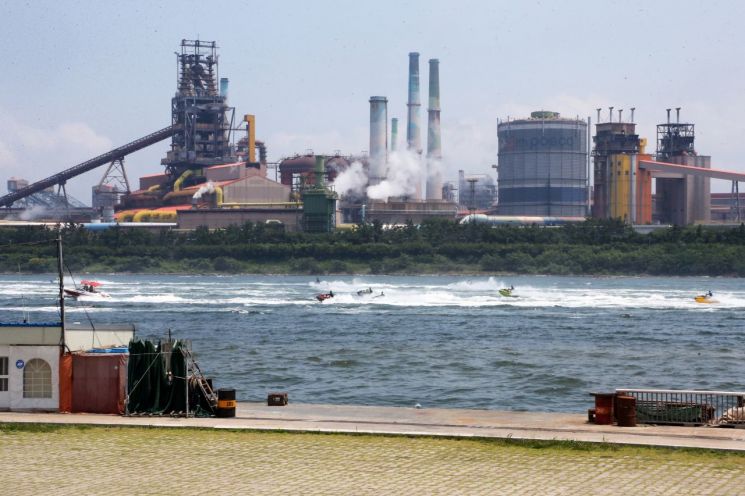
The steel industry is also preparing practical measures not only to respond to the carbon border adjustment mechanism but ultimately to achieve carbon neutrality by 2050. POSCO, which accounts for 70% of domestic steel industry's carbon emissions, declared in December last year that it aims to achieve carbon neutrality by 2050, becoming the first Asian steelmaker to do so. POSCO plans to reduce carbon emissions by 20% by 2030 and 50% by 2040 through hydrogen-based direct reduction steelmaking. To this end, it will supply eco-friendly products such as high-strength automotive steel sheets, high-efficiency electrical steel sheets, and renewable energy steel materials.
Kim Hak-dong, CEO (President) of POSCO, recently stated at a Federation of Korean Industries event, "The carbon neutrality project is a new paradigm industrial war," and projected that "approximately 68.5 trillion KRW will be required for eco-friendly management, including carbon neutrality."
© The Asia Business Daily(www.asiae.co.kr). All rights reserved.

















