Price Expected to Rise from Early 700,000 KRW to 1,000,000 KRW per Ton
Chosun 3 Companies Must Reserve Price Increase Provisions for Thick Plates
Good Order Performance but Profitability Declines
Steel Industry Takes Tough Stance Amid Iron Ore Price Surge
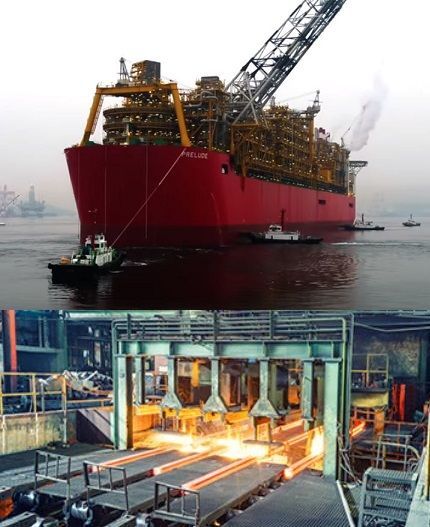
[Asia Economy Reporter Hwang Yoon-joo] The tug-of-war between the shipbuilding and steel industries over the price of thick plates in the second half of this year is intense. While POSCO is reported to have proposed a price of 1.15 million KRW per ton, a 53.3% increase compared to the first half of the year, the shipbuilding industry is expressing reluctance, citing concerns over losses due to the sharp product price hike.
According to industry sources on the 18th, the shipbuilding and steel industries are still negotiating over POSCO's proposed thick plate price of 1.15 million KRW for the second half. Usually, negotiations for the second half are concluded by June, but this year, narrowing the gap in positions has been difficult, causing delays beyond expectations.
The shipbuilding industry considers POSCO's proposed thick plate price excessively high. Generally, the price of ships is about 100 billion KRW for a VLCC and 120 to 130 billion KRW for a 20,000 TEU container ship. When building one ship, thick plates account for about 20% to 30% of the total cost. Dong-ik Jeong, a researcher at KB Securities, analyzed, "If the price is decided at 1.15 million KRW as POSCO demands, the additional steel cost for building one VLCC will reach 17.25 to 19.35 billion KRW," adding, "To offset this, new ship prices would need to increase by 15.5% to 17.4%."
The steel industry's proposed increase rate for thick plate prices is 53.3%. The shipbuilding industry complains that this far exceeds the rise in iron ore and new ship price indices, making losses inevitable.
In fact, the price of iron ore rose 34.4% from 161.8 USD per ton at the beginning of the year (January 1) to 217.47 USD (July 2). Last month, the new ship price index was 138.5 points, marking the highest level in seven years since July 2014 (140), but it still remains below the boom period. A shipbuilding industry official said, "The new ship price index only rose about 11 points compared to the beginning of the year," adding, "Considering labor costs, dock operation costs, and other material costs, it is still difficult to make a profit."
The steel industry also has much to say. Although iron ore prices have been rising continuously over the past two years, thick plate price increases have not been properly implemented. Iron ore prices surged from 72.63 USD on January 4, 2019, to 85.07 USD on March 8, 91.49 USD on April 5, and 104.30 USD on May 24. Although the upward trend slowed, prices soared again from last year due to COVID-19 and reached a peak of 226.46 USD in May this year.
An official from the steel industry said, "Iron ore price increases have continued for 2 to 3 years, but since the domestic shipbuilding industry has been facing a 'order cliff' situation, prices have effectively been frozen for years," adding, "During the shipbuilding boom, the industry demanded 'overcapacity' expansions, but ultimately bore all the losses, making price increases unavoidable."
© The Asia Business Daily(www.asiae.co.kr). All rights reserved.

















