Korea Advanced Institute of Science and Technology, Long-term Observation of Recovered Patients Shows Memory T Cells Prevent Severe Progression
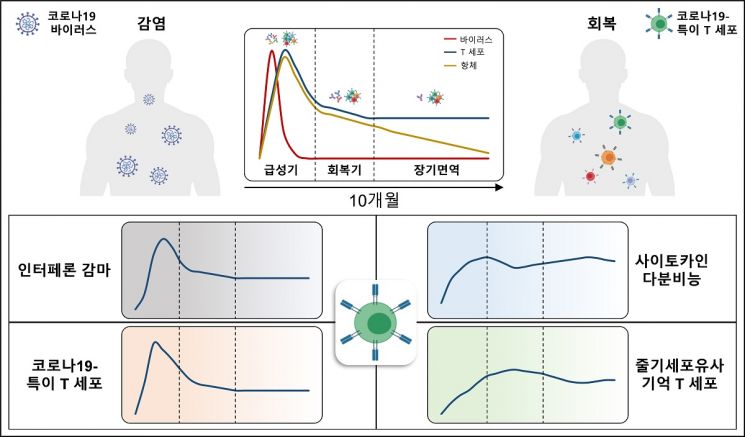
[Asia Economy Reporter Kim Bong-su] Memory T cells that prevent progression to severe disease after recovering from COVID-19 have been found to be well maintained even after 10 months. This discovery by domestic researchers explains why patients infected with COVID-19 for the second time rarely progress to severe illness.
The Korea Advanced Institute of Science and Technology (KAIST) announced on the 7th that a joint research team led by Professor Shin Ui-cheol of the Graduate School of Medical Science and Engineering revealed that memory T cells in COVID-19 survivors are well maintained for 10 months, and particularly, stem cell-like memory T cells are efficiently generated.
Memory T cells that defend against severe COVID-19 are maintained for a long time, so when reinfected, the disease rarely progresses to a severe stage.
After recovering from COVID-19 once, defensive immunity is generated through neutralizing antibodies and memory T cells. However, neutralizing antibodies against the COVID-19 virus are known to decrease over time, which has recently increased interest in memory T cells.
Memory T cells are important immune cells known to prevent progression to severe COVID-19, although they do not prevent the initial infection itself. However, it was not clearly known how long memory T cells can be maintained in COVID-19 survivors and whether their functions are well preserved over a long period.
The research team conducted a 10-month longitudinal study on Korean COVID-19 survivors to examine the characteristics and longevity of memory T cells against the COVID-19 virus. Using cutting-edge immunological research techniques, they analyzed the generation of stem cell-like memory T cells, which are important for long-term maintenance, and the presence of multifunctional memory T cells that perform multiple functions simultaneously.
As a result, the team confirmed that memory T cells appearing immediately after recovery from COVID-19 were well maintained during the 10-month follow-up. They also found that memory T cell maintenance was well observed in most survivors regardless of whether the initial COVID-19 infection was mild or severe. Even after 10 months, upon re-encountering the COVID-19 virus antigen, memory T cells actively proliferated and exhibited multifunctionality by performing various functions simultaneously. The research team suggested that this indicates the defensive immune function of memory T cells will be well expressed when survivors are re-exposed to the COVID-19 virus.
The team particularly identified that stem cell-like memory T cells are well generated in COVID-19 survivors. Stem cell-like memory T cells have regenerative functions that maintain the number of memory T cells over a long period. According to the research team, this study suggests that memory T cells in COVID-19 survivors will be well maintained for a considerably long time. This is the first report worldwide on the generation of stem cell-like memory T cells after COVID-19 recovery.
This research was published on the 30th of last month in the international academic journal Nature Communications.
Jung Jae-hyung, a doctoral researcher at KAIST, said, "We confirmed that memory T cell immune responses are maintained for up to 10 months after recovery from COVID-19," adding, "Through identifying the characteristics and functions of stem cell-like memory T cells, which are predicted to play an important role in the persistence of this defensive immunity, we have established important indicators for understanding reinfection and evaluating memory T cells induced by COVID-19 vaccines."
© The Asia Business Daily(www.asiae.co.kr). All rights reserved.

















