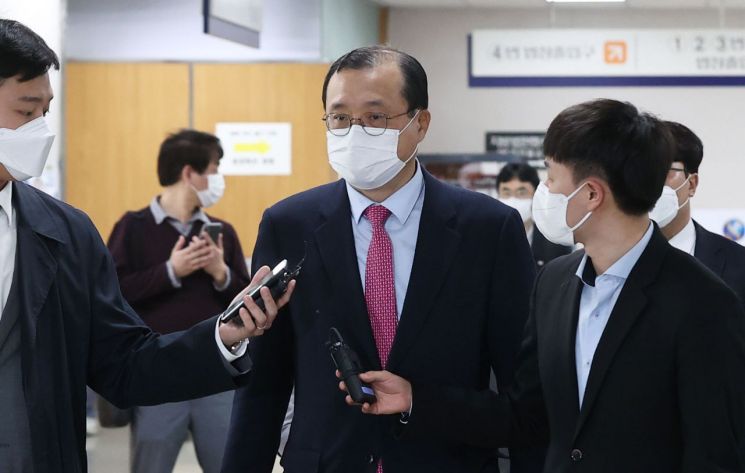
[Asia Economy Reporter Kim Hyung-min] In the trial of former High Court Chief Judge Im Seong-geun, who was impeached on charges of interfering with a trial, both sides clashed over whether a dismissal sentence is possible for a judge whose term has expired.
The Constitutional Court held the second hearing for former Chief Judge Im at 2 p.m. on the 6th in the Grand Bench courtroom.
At this trial, as in the first hearing, both sides opposed each other over the legality of impeachment rulings against judges whose terms have expired, the elements of abuse of authority under criminal law, and the requirements for impeachment.
The representatives of the National Assembly emphasized that a 'not guilty' verdict on abuse of authority does not necessarily mean 'not subject to impeachment.' They argued that constitutional duties are a much broader concept than criminal abuse of authority, and that former Chief Judge Im’s interference in the trial violated the constitutional duties of a judge.
They also stated, "It is itself a threat to judicial independence to say that if the judge subject to trial interference maintains their conviction, it is not a problem," emphasizing that "the principle of judicial independence should not be narrowly interpreted."
They repeatedly stressed that term expiration and dismissal have different effects, and that a judge does not have to be an incumbent to be subject to impeachment. They further argued that dismissal could be 'retroactively sentenced' effective from February 28, the expiration date of former Chief Judge Im’s term.
On the other hand, former Chief Judge Im’s side maintained their previous position that a retroactive dismissal decision is 'unconstitutional' and should be dismissed or rejected.
They also emphasized that if impeachment is possible for officials whose terms have expired, the provision in the National Assembly Act that prohibits dismissal of impeached officials to guarantee the effectiveness of dismissal would become meaningless.
Former Chief Judge Im’s side criticized, "The claim that dismissal decisions should be retroactively applied to the expiration date of the respondent’s term is an argument tailored to the conclusion desired by the petitioner."
Former Chief Judge Im attended the first hearing held on the 10th of last month but did not appear on this day. Yoon Ho-jung, floor leader of the Democratic Party and a National Assembly impeachment committee member, also did not attend.
Former Chief Judge Im is suspected of interfering in the trial of the Seoul bureau chief of the Japanese Sankei Shimbun, who was indicted on defamation charges for raising the '7-hour Sewol ferry mystery' involving former President Park Geun-hye.
In the first trial, he was acquitted based on the legal principle that 'there is no abuse of authority without authority.' However, the National Assembly passed an impeachment motion on the grounds that his actions were 'unconstitutional.' Former Chief Judge Im’s term expired on February 28, and he has since left the bench.
The court has scheduled the final hearing for the 10th of next month. After the final hearing, the court will deliberate based on both sides’ opinions and then reach a conclusion.
© The Asia Business Daily(www.asiae.co.kr). All rights reserved.
![Clutching a Stolen Dior Bag, Saying "I Hate Being Poor but Real"... The Grotesque Con of a "Human Knockoff" [Slate]](https://cwcontent.asiae.co.kr/asiaresize/183/2026021902243444107_1771435474.jpg)
















