Reducing Deicing Agent Corrosion and Controlling Prices... Leading Public Procurement Market Share
"100% Recycling of Bulgari"... Developing Liquid Fertilizer from Remaining Waste Liquid
Discussing Supply Contracts with Canada and Others... Aiming to Expand Exports Within 2-3 Years

[Asia Economy Reporter Junhyung Lee] The government purchases about 3,600 tons of starfish from fishermen every year to control the population of starfish, an invasive species disrupting the marine ecosystem. Starfish have excellent regenerative abilities and are difficult to kill. Due to their toxicity and foul odor, they cannot be used as fertilizer and must all be incinerated.
StarsTech, a deicing agent manufacturer, found an opportunity here. Yang Seungchan, CEO of StarsTech, developed an eco-friendly deicing agent using substances extracted from starfish. The idea came from the fact that a porous structure obtained by removing protein from starfish absorbs chloride ions from conventional deicing agents. Chloride-based deicing agents, which are based on salt and calcium chloride, melt snow while releasing chloride ions. These ions corrode roads and vehicles and have harmful effects on soil and other environments. CEO Yang explained, "There are non-chloride deicing agents made from substances like acetate, but they are about 20 times more expensive than salt-based deicing agents," adding, "While corrosion is effectively suppressed, the downside is that being organic materials, they inevitably cause ecological damage."

StarsTech’s deicing agent reduces corrosion rates like non-chloride deicing agents while maintaining competitive pricing. Its corrosion rate is about 0.08% of that of standard salt-based deicing agents. Priced at 300,000 to 350,000 KRW per ton, it is about twice as expensive as calcium chloride deicing agents (150,000 to 200,000 KRW), but considerably cheaper than existing eco-friendly deicing agents. The government’s annual free provision of 200 to 300 tons of starfish helped secure price competitiveness.
Local governments are required to spend a certain percentage of their public procurement budgets on eco-friendly products each year, leading to a flood of inquiries nationwide. Thanks to the interest from local governments and facility management corporations, the company achieved the number one market share for eco-friendly deicing agents in the domestic public procurement market within three years of its establishment. CEO Yang said, "StarsTech’s deicing agent has received almost all certifications available for deicing agents in Korea, including Excellent Procurement Product and Green Certification," adding, "Local governments receive additional points when purchasing our products."
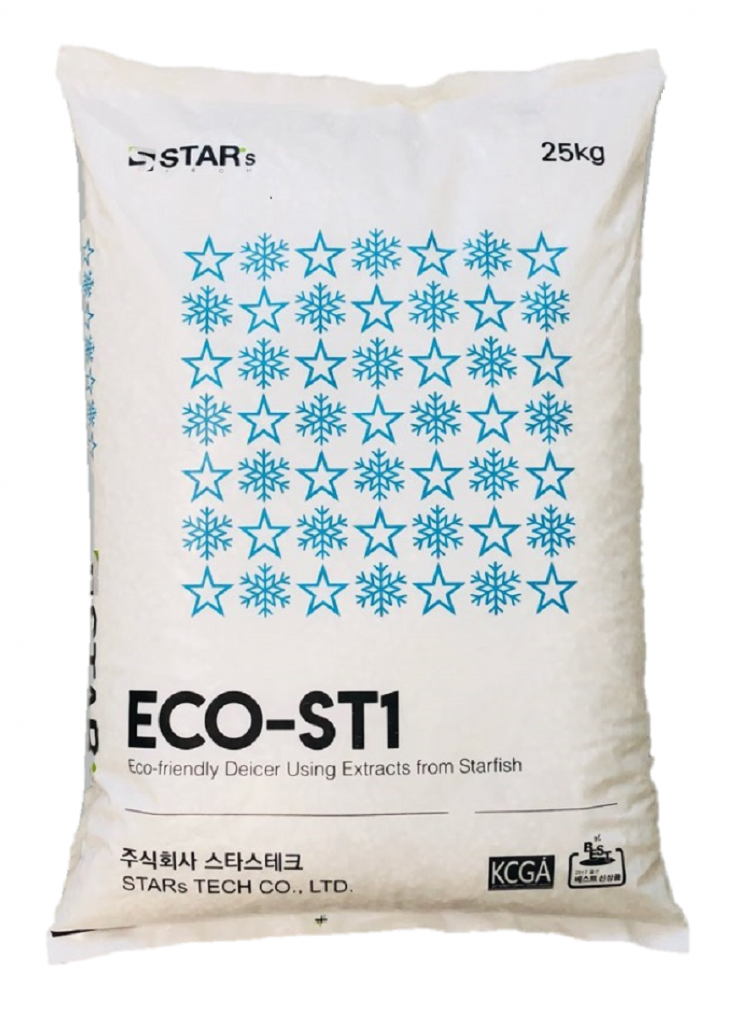 An eco-friendly de-icing agent developed and produced by StarsTech using substances extracted from starfish.
 [Photo by StarsTech]
CEO Yang’s next goal is ‘100% recycling’ of starfish. Currently, StarsTech recycles starfish during the deicing agent production process, but some still need to be disposed of. The company, in collaboration with researchers from Korea University, developed ‘Phenellagen,’ a cosmetic raw material extracted from collagen derived from starfish. Recently, they have been actively developing technology to produce liquid fertilizer by recycling the remaining waste liquid after extracting various substances from starfish. Once these two technologies are commercialized, starfish can be recycled without any waste.
Exports are also imminent. About 80% of the company’s sales come from the domestic public procurement market. However, the company aims to increase exports so that export volumes exceed domestic sales within two to three years. Currently, the company is negotiating three supply contracts with countries including Canada. In Slovakia, they have begun establishing overseas production facilities.
They are also considering sourcing Australia’s ‘crown-of-thorns starfish.’ This starfish, which can reach up to 1 meter in body size, is a major culprit in destroying Australia’s coral reefs. CEO Yang said, "We conducted experiments directly with the crown-of-thorns starfish and found that the performance of the porous structure is the same as that of domestic starfish," adding, "If domestic starfish supply becomes unstable, we are considering establishing an extraction and production base in Australia."
© The Asia Business Daily(www.asiae.co.kr). All rights reserved.
![Clutching a Stolen Dior Bag, Saying "I Hate Being Poor but Real"... The Grotesque Con of a "Human Knockoff" [Slate]](https://cwcontent.asiae.co.kr/asiaresize/183/2026021902243444107_1771435474.jpg)


















