DGIST Professor Kim Cheol-gi's Team "Enables Precise Individual Cell Analysis"
[Asia Economy Reporter Kim Bong-su] A technology that can classify and precisely analyze cells using magnetic fields has been developed.
The research team led by Professor Kim Cheol-gi of the Department of New Materials Science at Daegu Gyeongbuk Institute of Science and Technology (DGIST) announced on the 5th that they have developed a magnetic tweezing technology that controls and analyzes multiple cells using magnetism. DGIST explained that this technology makes precise individual cell analysis easier and can become a groundbreaking core technology in the biomedical field, such as disease-tailored treatment and new drug development.
The research team succeeded in simply and effectively controlling thousands of cells and superparamagnetic particles through magnetic field control. Superparamagnetic particles are tiny magnetic materials that act as carriers moving cells, and by filling the space around cells with these particles, specific cells can be precisely controlled.
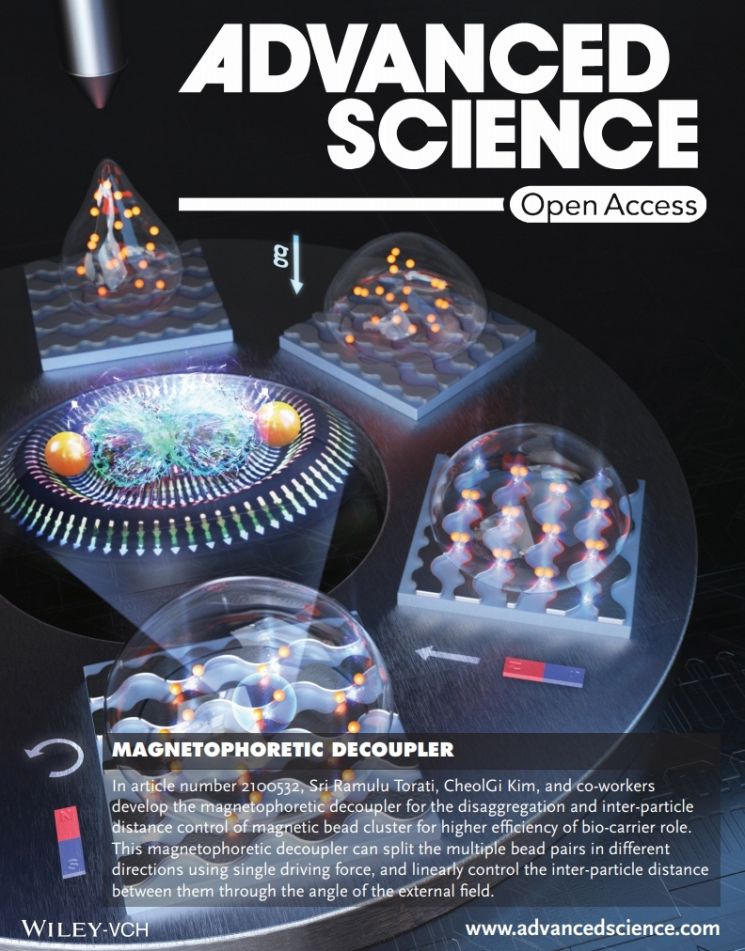
The team also moved each cell according to a special-shaped micro magnetic pattern, classified them by size, and then individually captured multiple cells at desired locations. Since the pattern itself judges the target, this method has the advantage of not requiring external equipment used in previous technologies. Furthermore, they independently developed a magnetic tweezing platform that complements the limitations of existing magnetic-based platforms, such as the aggregation problem of magnetic materials. Through experiments, the team succeeded in separating aggregated magnetic materials at hundreds of locations simultaneously at equal intervals using intentionally asymmetrical magnetic patterns.
Cells that make up living organisms grow and regulate themselves through various differentiation processes. When these cells function abnormally, they cause various diseases or cancer cells. Due to the different characteristics of numerous cells, single-cell research is necessary to reveal cell interactions and other phenomena.
Single-cell research requires technology to isolate cells so that multiple cells do not mix. Until now, optical tweezers technology, which uses optical pressure to move cells, has been mainly used. This requires external processing such as image recognition using fluorescent labeling to distinguish different cells. Additionally, existing magnetic-based technologies require prior information about the cell surface for single-cell control, leading to additional processes and costs.
Professor Kim Cheol-gi explained, “The biggest advantage is achieving the same results as complex equipment simply by changing the shape of micro magnets, and control is possible only by the angle of the rotating magnetic field without complicated settings.” He added, “We have developed for the first time a technology that individually controls both labeled and unlabeled cells for specific purposes, beyond the existing technology that separates only labeled cells.” Professor Kim further stated, “Based on magnetic fields that have the least impact on cells, this technology is expected to be utilized in single-cell scale research, various early diagnoses, and personalized medicine.”
The research results were published online on May 21 in Nature Communications. Additionally, on the 26th of last month, the paper was selected as the cover article of Advanced Science.
© The Asia Business Daily(www.asiae.co.kr). All rights reserved.
![User Who Sold Erroneously Deposited Bitcoins to Repay Debt and Fund Entertainment... What Did the Supreme Court Decide in 2021? [Legal Issue Check]](https://cwcontent.asiae.co.kr/asiaresize/183/2026020910431234020_1770601391.png)
















