Peak Season Giveaway and Discount Competition from July to September
Event Products Expanded to Fresh Foods and Daily Necessities
2nd and 3rd Place Manufacturers Aim to Increase Market Share
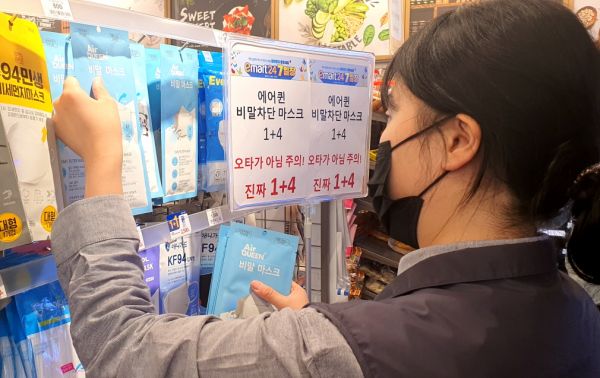
[Asia Economy Reporter Jo In-kyung] Along with vaccination efforts, convenience stores are fiercely competing to win back customers lost due to COVID-19. The 'Buy 1 Get 1 Free' marketing has expanded to larger scales and more diverse items, such as 'Buy 1 Get 2 Free,' 'Buy 3 Get 2 Free,' and 'Buy 1 Get 4 Free.' With the peak summer vacation season approaching, various promotions are being held to attract customers, but we took a closer look at who, why, and how these bonus marketing campaigns are created behind the scenes.
Why the Fierce Discount Competition Among Convenience Stores
Convenience stores’ bonus marketing targets one- to two-person households. Since the spread of COVID-19, more customers have been shopping at nearby convenience stores instead of large supermarkets, and the purchase amount per customer has increased. As one- to two-person households have grown, many customers prefer small-portion products at convenience stores. Since buying in bulk at large supermarkets is too much and visiting convenience stores frequently is inconvenient, various bonus marketing campaigns have started to attract consumers seeking rational consumption as regular customers.
An industry insider explained, "COVID-19 changed consumers’ shopping habits, and customers who have purchased daily necessities and ingredients at convenience stores now perceive them as not more expensive than large supermarkets. Even after COVID-19, we are thinking about how to keep customers as regulars (lock-in effect)."
Bonus promotions directly increase convenience store sales. Typically, promotional products sell 30-40% more than when not on promotion. For products with Buy 1 Get 1 Free promotions, sales can be two to three times higher compared to months without the promotion. For example, CU increased the number of promotional products handled in stores from about 1,000 last year to about 1,200 this year, and sales of these items grew by more than 20% compared to the same period last year.
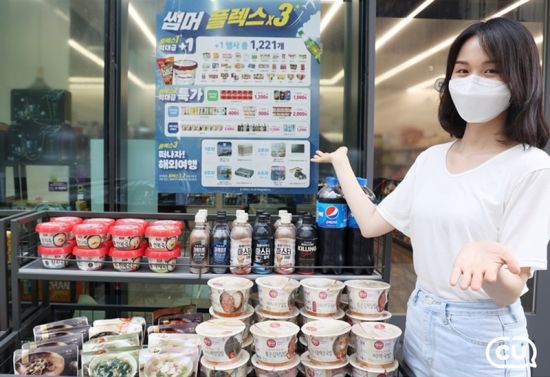
Numbers That Grab Attention
The most common bonus promotions at convenience stores are 2+1 or 1+1. Consumers can get two items for the price of one, or three items for the price of two, enjoying discounts of 50% and 33%, respectively.
Recently, promotions offering more free items than purchased ones have appeared, such as 3+2, 1+2, and 1+4. At Seven Eleven, from the 7th to the 31st, customers can buy three 'Cantata Americano (200ml)' for 3,900 KRW at the price of one (1,300 KRW), resulting in a 66.7% discount. Emart24 is selling 'Air Queen KF-AD' products containing two droplet-blocking masks (1,500 KRW) with a 1+4 promotion until the 7th.
There are also promotions where the more you buy, the cheaper the price. CU is selling seven types of processed milk, including strawberry-flavored milk (1,500 KRW), with a 2+1 promotion throughout July, and has introduced a 'tiered discount' system where purchasing five or more applies a unit price of 900 KRW.
The range of products eligible for bonus promotions is also expanding. From beverages and snacks to fresh foods like tofu and fruit, as well as various daily necessities and luxury items.
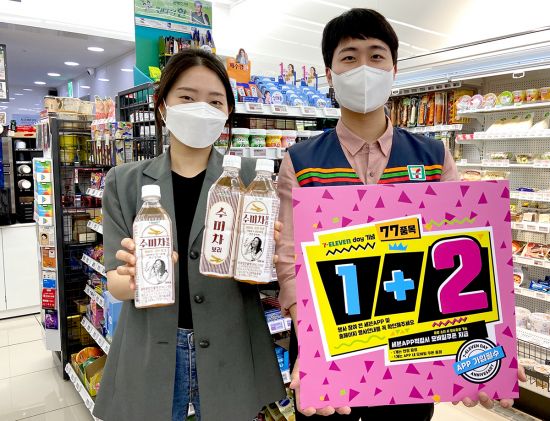
Costs Shared by 2nd and 3rd Place Companies and Convenience Store Headquarters
The costs of bonus promotions are shared equally between convenience stores and the manufacturers supplying the products. The bonus marketing is mainly applied to products ranked 2nd or 3rd in the convenience store product categories. Market leaders like 'Shin Ramyun' and 'Binggrae Banana Milk' do not participate in bonus promotions. Additionally, many companies conduct bonus marketing alongside new product launches.
So, are these products really cheaper than those in other distribution channels? The industry explains that many convenience store products differ in volume and other factors from large supermarket products, making simple comparisons difficult.
A convenience store official said, "Supermarkets basically sell large volumes at low prices, so packaging and volume differ from the small-portion products at convenience stores. For one- to two-person households, considering the time and cost to travel to distant supermarkets and the food waste, convenience store products offer competitiveness by being convenient and allowing customers to purchase cheaply using various benefits."
© The Asia Business Daily(www.asiae.co.kr). All rights reserved.














