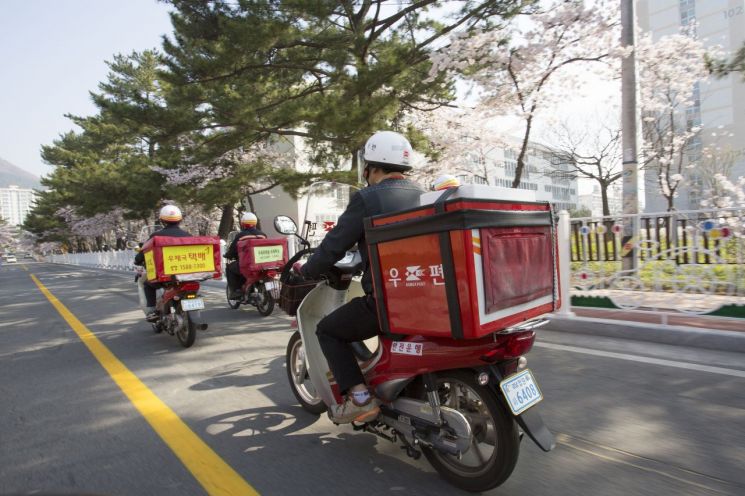
[Asia Economy Reporter Kim Bong-su] The Korea Post, which suffered turmoil due to the courier union strike, has decided to abolish the 'Post Office Courier' brand after 20 years and change it to 'Post Office Parcel.' The term 'parcel' is currently used only at post offices, and with 'courier' being a more commonly used term, the sudden name change has attracted attention. There is an interpretation that this is a repercussion of the recent courier union strike.
On the 30th, the Korea Post announced that it would change the brand name 'courier,' which has been in use for 20 years, to 'parcel.' The term 'parcel' is the official name for small cargo transportation services provided by post offices, along with regular letters and registered mail, since the introduction of the modern postal system in 1884.
The Korea Post began offering visit parcel acceptance services in August 1999, around the time private courier services became active. From February 2001, it was branded as 'Post Office Courier.' It has gained popularity, increasing from 210 million items in 2016 to 320 million items last year.
Regarding the sudden name change after 20 years, the Korea Post stated that it is to use the official term 'parcel' as defined by the Postal Service Act. Going forward, the post office BI (Brand Identity) will be registered as 'Post Office Parcel,' and the name used in related laws (32 in total), various promotional materials, parcel boxes, waybills, and vehicles will be changed sequentially.
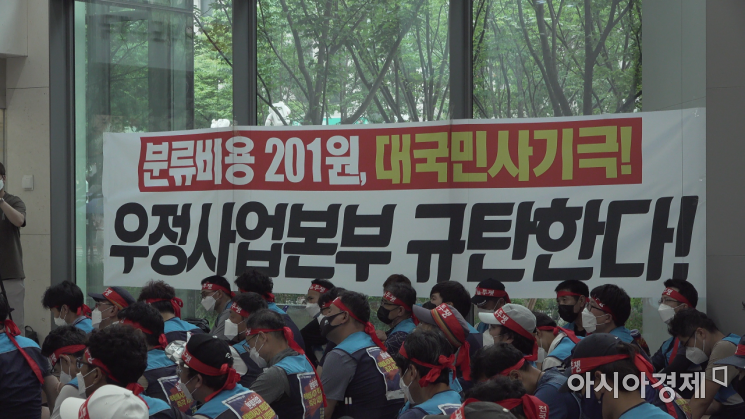
In this context, the Korea Post faced difficulties as post office courier workers took the lead in the recent strike demanding measures to prevent overwork deaths. The Korea Post manages about 3,500 workers appointed as special employment workers through the Post Office Logistics Support Group to carry out courier tasks. Among them, about 2,500 participated in the nationwide courier union strike held from the 9th to the 16th. Around 120 workers occupied and protested in the lobby of the Yeouido Post Office building for three days. After the strike ended, two of them tested positive for COVID-19 just before returning to work, raising concerns about a 'second wave of cluster infections' stemming from the gathering.
The Korea Post was particularly taken aback by the strike, as it already provides much better treatment to post office courier workers compared to general private companies. According to the Korea Post, private courier drivers work six days a week, averaging 72 to 84 hours per week, with about 4 hours of sorting work daily. In contrast, post office courier delivery workers work five days a week, averaging 48 to 54 hours weekly, with only 2 hours and 12 minutes of sorting work daily. The average daily delivery volume is also lower for post office workers at 190 items compared to 260 items for private couriers, a difference of 70 items. Additionally, post office delivery workers do not have agency management fees, whereas private couriers must pay 13 to 15% of their sales. As a result, post office delivery workers earn about 600,000 KRW more per month. Furthermore, post office delivery workers are guaranteed one summer vacation and leave for family events annually under labor-management agreements, with delivery volumes handled by the Post Office Logistics Support Group during their leave. Private couriers, on the other hand, must manage their own vacations and substitute deliveries.
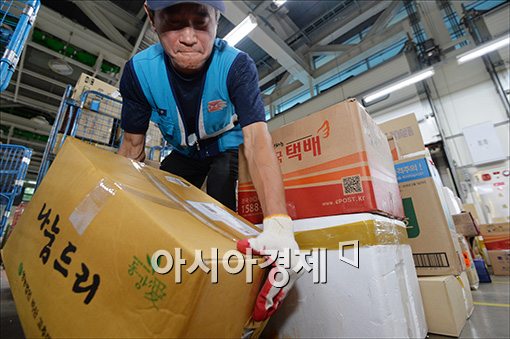
Moreover, dissatisfaction was high among government-employed postal carriers who handled some of the post office courier volumes during the strike. The National Public Transport Union Korea Post Headquarters, affiliated with the Korean Confederation of Trade Unions, held a press conference on the 10th, claiming, "The Korea Post is easily using post office postal carriers as scapegoats to neutralize the courier union's delivery refusal and shifting responsibility onto the postal carriers." Conversely, the Korea Post Union, affiliated with the Federation of Korean Trade Unions and the representative negotiating union, argued on the 9th that "the consignment contract should be completely terminated, private sector courier business abolished, and the number of regular postal carriers increased so that volumes can be handled independently." The Korea Post Union also held a meeting with the Korea Post on the 14th, agreeing to change the brand name from 'courier' to 'parcel,' and staged rallies at the Ministry of Science and ICT building in Sejong City as part of their offensive.
© The Asia Business Daily(www.asiae.co.kr). All rights reserved.


















