[Sejong=Asia Economy Reporter Joo Sang-don] It has been revealed that the concentrations of 23 types of persistent organic pollutants (POPs) in South Korea have continuously decreased over the past 11 years.
The Ministry of Environment announced on the 30th that it will publish the "Persistent Organic Pollutants Environmental Monitoring White Paper" on the 1st of next month, which contains the results of measuring the concentrations of persistent organic pollutants in the atmosphere, water quality, soil, and sediments from 2008 to 2018.
Following South Korea's accession to the Stockholm Convention in January 2007, the Ministry of Environment began measuring the concentrations of 23 persistent organic pollutants listed in the convention, including dioxins, to verify the effectiveness of the convention's implementation.
The measurement results showed a decreasing trend in the concentrations of persistent organic pollutants in all media, including the atmosphere, every year. Among pesticides such as aldrin, dieldrin, endrin, and toxaphene, 13 types showed a yearly decreasing trend or were detected in trace amounts or not detected at all in the atmosphere, soil, water quality, and sediments.
DDT, an insecticide banned internationally since the 1970s, showed a gradual decrease in all media including atmosphere, water quality, soil, and sediments. From 2015 to 2018, the detected concentration in soil ranged from 0.678 to 2.098 ng/g, which was lower compared to China (21.41 to 162 ng/g), the United States (average 53.7 ng/g), and Canada (1 to 18 ng/g).
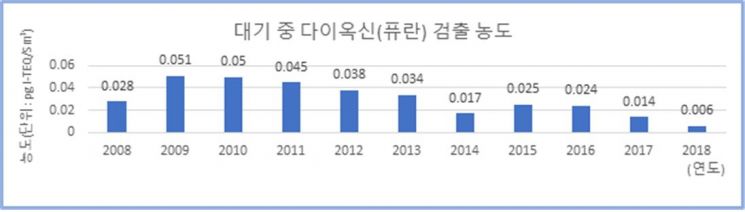
Dioxins (furans), by-products generated from industrial processes, also showed a decreasing trend every year in the atmosphere, water quality, soil, and sediments. In particular, the concentration of dioxins in the atmosphere decreased by 79%, from 0.028 pg I-TEQ/S㎥ in 2008 to 0.006 pg I-TEQ/S㎥ in 2018. The detected concentration of dioxins in 2018 was 100 times lower than the atmospheric environmental standard of 0.6 pg I-TEQ/S㎥. This level is similar to concentrations surveyed in Japan and Hong Kong and lower than that of China.
Park Yong-gyu, Director of the Environmental Health Policy Bureau at the Ministry of Environment, stated, "In the future, we plan to expand the measurement of persistent organic pollutant concentrations beyond existing environmental media such as the atmosphere to include animals, plants, and humans." The Ministry of Environment plans to distribute the Persistent Organic Pollutants Environmental Monitoring White Paper to related organizations. The white paper can be accessed on the Ministry of Environment's website.
© The Asia Business Daily(www.asiae.co.kr). All rights reserved.
![Clutching a Stolen Dior Bag, Saying "I Hate Being Poor but Real"... The Grotesque Con of a "Human Knockoff" [Slate]](https://cwcontent.asiae.co.kr/asiaresize/183/2026021902243444107_1771435474.jpg)
















