Gopbus, No.1 Institutional Net Buyer on 29th
Inverse Also Net Bought Worth 15.6 Billion KRW
KOSPI Hits 3300 Then Profit-Taking
Possibility of Correction Explored in Securities Firms
 The KOSPI surpassed the 3,300 mark for the first time in history. On the 25th, the KOSPI index opened at 3,289.18, up 3.08 points (0.09%), and extended its gains to break the intraday record of 3,292.27 set the previous day. The photo shows the Hana Bank dealing room in Jung-gu, Seoul, on that day. Photo by Kim Hyun-min kimhyun81@
[Asia Economy Reporter Hwang Junho] On the 29th, when the KOSPI's upward momentum slowed, institutional and foreign investors concentrated on buying Gopbus (KODEX 200 Futures Inverse 2×). This is analyzed as a growing expectation of a market correction due to profit-taking following the KOSPI surpassing 3300 for the first time in history and the spread of the COVID-19 Delta variant.
According to the Korea Exchange as of 10:31 AM on the 30th, Gopbus ranked first in net purchases by institutions and foreigners. On the 29th, institutions also bought the most Gopbus in the KOSPI, with a net purchase amounting to 50.83194 billion KRW. Gopbus is a compound product combining inverse and leverage that moves opposite to the KOSPI 200. The inverse product yields profits when stock prices fall, and Gopbus yields twice the profit.
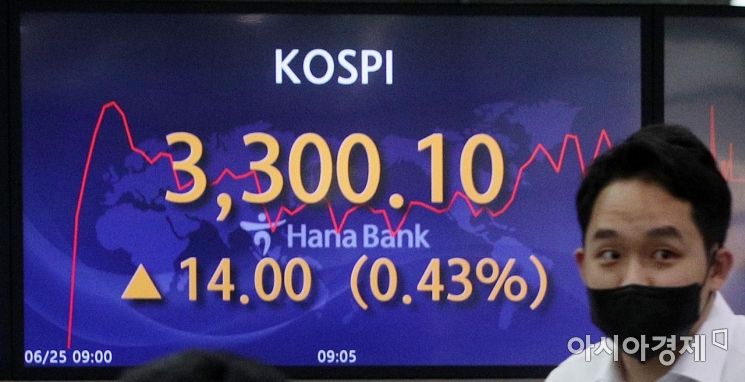 The KOSPI surpassed the 3,300 mark for the first time in history. On the 25th, the KOSPI index opened at 3,289.18, up 3.08 points (0.09%), and extended its gains to break the intraday record of 3,292.27 set the previous day. The photo shows the Hana Bank dealing room in Jung-gu, Seoul on that day. Photo by Hyunmin Kim kimhyun81@
Following Gopbus on the 29th, the inverse product also filled a corner of the institutions' shopping basket. Institutions made net purchases of KODEX Inverse worth 15.68353 billion KRW, ranking second after Gopbus.
Institutions had been leading sales of Gopbus until the 25th, when the KOSPI surpassed 3300 and reached an all-time high, but started concentrated buying from the 28th. While foreigners were gradually accumulating Gopbus, institutions joined in. Foreigners made continuous net purchases of Gopbus from the 24th to the 29th, totaling about 46.4232 billion KRW. On the other hand, both groups sold leveraged products (KODEX Leverage) that invest in the rising KOSPI. On the 29th, institutions and foreigners made net sales worth 17.43810 billion KRW and 20.54969 billion KRW, respectively.
These movements by institutions and foreigners are analyzed as expectations of a market correction. As the KOSPI surged to 3300, the desire for profit-taking increased, and the COVID-19 Delta variant emerged as a new negative factor. The market actually underwent a slight correction and took a breather. Although individuals made net purchases worth 1.232 trillion KRW, institutions and foreigners made net sales of 681 billion KRW and 549.7 billion KRW, respectively, causing the KOSPI to close below the 3300 mark after two days. Seo Sang-young, a researcher at Mirae Asset Securities, analyzed, "The sluggishness in Asian markets due to the Delta variant has extended to Korea," adding, "The market declined due to foreign investors' selling of futures and spot assets amid concerns over delays in economic normalization."
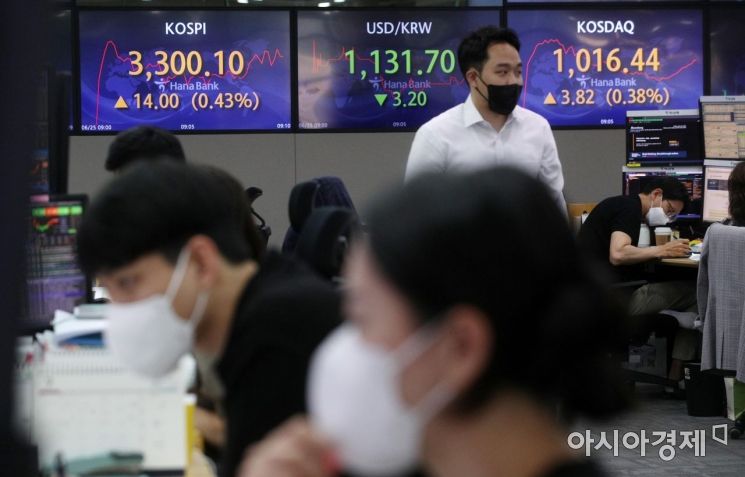 The KOSPI surpassed the 3,300 mark for the first time in history. On the 25th, the KOSPI index opened at 3,289.18, up 3.08 points (0.09%), and extended its gains to break the intraday record of 3,292.27 set the previous day. The photo shows the Hana Bank dealing room in Jung-gu, Seoul, on that day. Photo by Kim Hyun-min kimhyun81@
In the securities industry, forecasts emphasizing a market correction are emerging. Han Ji-young, a researcher at Kiwoom Securities, predicted, "The cautious sentiment during the Q2 earnings season and the expected increase in COVID-19 cases will burden the market."
The Investment Strategy Department of Korea Investment & Securities analyzed, "Concerns are spreading as Australia and Europe strengthen lockdown measures due to the Delta variant spread, highlighting safe-haven assets such as the US dollar." When the appeal of safe-haven assets increases, the attractiveness of risk assets like the stock market decreases. In fact, the Japanese yen, a representative safe currency, is showing stronger performance against the US dollar, and the Australian dollar has fallen the most among major dollars. As of 10:31 AM, the USD/KRW exchange rate rose 0.27% to 1,131.60 KRW.
© The Asia Business Daily(www.asiae.co.kr). All rights reserved.



















