Discussion on Strengthening Activity Areas and Development Foundations of Social Economy Organizations
Women and Family Sector Social Economy Organizations Account for Only 4.8%
Support for Discovering Various Models and Expanding Market Channels
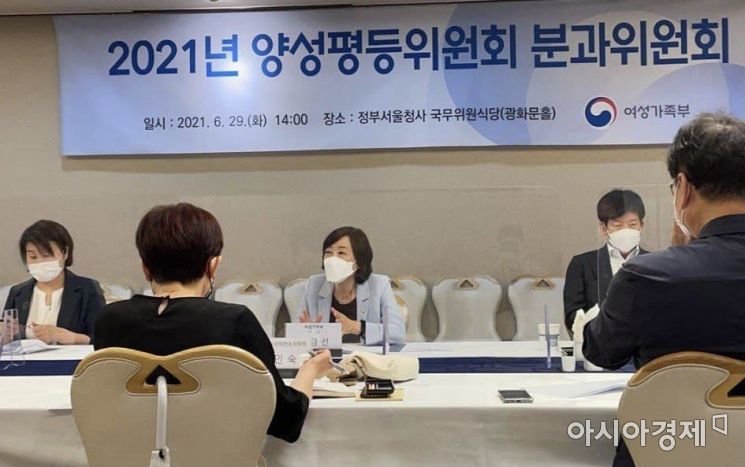 Kim Kyung-sun, Vice Minister of the Ministry of Gender Equality and Family, held a meeting of the Women's Participation Subcommittee in the Economic and Decision-Making Areas of the Gender Equality Committee at the Government Seoul Office on the 29th, discussing measures to revitalize the social economy in the field of women and family.
[Asia Economy Reporter Han Jinju] The government is expanding the activity areas of social economy organizations in the women and family sector to broaden social services necessary for diverse families, caregiving, and domestic labor.
On the 29th, the Ministry of Gender Equality and Family held the "Women's Participation in Economic and Decision-Making Areas Subcommittee" under the Gender Equality Committee to discuss measures to revitalize the social economy in the women and family sector.
Currently, there are 1,136 social economy organizations in the women and family sector, accounting for only 4.8% of all social economy organizations. Their activity areas are limited, and systematic support is insufficient. Accordingly, the government sought ways to strengthen activity areas and development foundations together with private experts.
To activate social economy organizations that contribute to filling caregiving gaps, the government decided to discover childcare social economy organization models utilizing government projects. Representative examples include the all-day care consignment operation model and the joint workplace daycare center model. Support will be provided so that childcare communities can be organized as cooperatives, among others.
To revitalize social economy organizations contributing to support for diverse families such as single-parent families, multicultural families, and single-person households, social cooperatives will be added to the eligibility criteria for the "Single-Parent Family Welfare Organization Support Public Project." The discovery of social economy organization models tailored to single-person households will also be promoted.
Alongside this, preparations will be made to activate social economy organizations that can operate as domestic service providers under the Domestic Workers Act, which will be enforced in June next year. Cooperative models supporting the improvement of undervaluation of domestic labor, fair compensation, and rights protection will be developed and organized.
To improve gender equality awareness in local communities, a cooperative system will be established with social economy organizations producing gender equality content in collaboration with local gender equality centers, spreading gender equality cultural and artistic content.
To foster social economy organizations, activities such as discovering excellent models and supporting organization will be supported. Targets for organizational support of social economy organization models will be identified and supported through consulting. Plans will also be made to develop franchise models for excellent models by sector that can be expanded nationwide in the future.
Support will also be provided to strengthen competitiveness through design development and improvement, promotional content production, quality certification, and market development. Unlike women-owned and managed companies and cooperatives meeting certain requirements, social cooperatives have not been recognized as women-owned businesses under current law; this will be revised to allow participation in women business support projects.
Kim Kyung-sun, Vice Minister of the Ministry of Gender Equality and Family, said, "Social economy organizations in the women and family sector have a small share and lack systematic support, so tailored support policies that expand activity areas and strengthen development foundations are necessary. We will actively support them to contribute to strengthening the social safety net, restoring communities, and ultimately creating quality jobs."
© The Asia Business Daily(www.asiae.co.kr). All rights reserved.

















