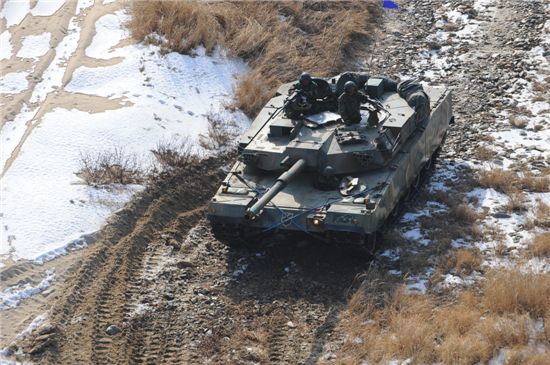
 The K1 tank underwent simplification of the turret structure, including changes to the gunner's aiming device according to the mass production stage.
[Asia Economy Yang Nak-gyu, Military Specialist Reporter] Hyundai Rotem has secured a contract worth 506.7 billion KRW for the overhaul of K1 and K1A1 tanks, as well as K-1 recovery and bridge-laying tanks.
According to Hyundai Rotem on the 29th, the contract amount for the overhaul project awarded by the Defense Acquisition Program Administration is 234.6 billion KRW for K1 tanks, 100.6 billion KRW for K1A1 tanks, and 171.5 billion KRW for K-1 recovery and bridge-laying vehicles. The contract period is until November 29, 2024, for K1 and K1A1 tanks, and until November 30, 2023, for recovery and bridge-laying tanks.
Overhaul refers to the process of disassembling old tanks for repairs, parts replacement, and maintenance work to restore performance to a level comparable to new vehicles.
A Hyundai Rotem official said, "Through this contract, we have continued our trend of securing overhaul orders and established a stable source of revenue. We will continue to enhance our competitiveness in maintenance and overhaul to contribute to strengthening military capabilities."
Meanwhile, some argue that the performance of K1 and K1A1 tanks is urgently needed to be improved in response to North Korea's anti-tank rockets. North Korea is accelerating the development of projectiles capable of penetrating our military’s tanks. The kinetic and chemical energy rounds used by North Korea’s T-54 tanks, Seongunho, and Cheonmaho can penetrate our K1 and K1A1 tanks. North Korea employs chemical energy rounds that can penetrate armor thicknesses of 550mm and new chemical energy rounds capable of penetrating 900mm. Considering that the armor thickness of the K-1 tank is 350mm, it is said that our tanks are defenseless against these threats.
The Army requested a review from the Joint Chiefs of Staff because the first phase of the performance improvement project excluded protection against North Korean anti-tank missiles. The Army argues that to enhance the tank’s armor protection, the tank’s thickness must be increased, which would increase the tank’s weight from 51 tons to 57 tons, resulting in slower speed. Therefore, upgrading the 1,200-horsepower engine and transmission (powerpack) is inevitable.
© The Asia Business Daily(www.asiae.co.kr). All rights reserved.
















