Changes in 'Urban Policy Systems' Reflect Long-Term 'Urban Spatial Structure' Settings
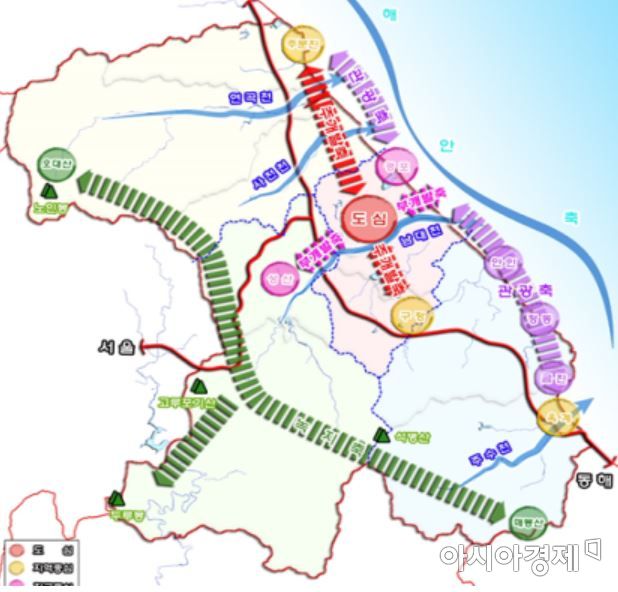
[Asia Economy Reporter Ra Young-cheol] Gangneung City announced on the 29th that the "2035 Gangneung Urban Master Plan" was finally conditionally approved by the Gangwon-do Urban Planning Committee on the 25th.
According to the city on that day, the "2035 Gangneung Urban Master Plan" is a roadmap presenting the future vision and long-term development plan of Gangneung City, which has been promoted since May 2018.
Estimating land demand due to urban development 15 years later, the city finalized the land use plan by designating 19.776㎢ of developable land as planned urbanization land, 31.243㎢ of existing developed land as urbanized land, and the remaining 995.862㎢ (hereinafter referred to as "undesignated area") as conservation land.
The main contents include urban policies and institutional changes due to population decline, long-term urban spatial structure setting, living zone establishment and population distribution plans, smart city creation, and metropolitan and urban transportation plans in preparation for the ITS World Congress.
It reflects changed urban conditions such as the opening of the KTX Gangneung Line, the Donghae Northern Line (Gangneung~Jejin), the Namgangneung IC inland ITS Hvb industrial and logistics hub city, and the revitalization of coastal transport at Okgae Port (national fishing port), as well as promoting balanced development in the southern region.
The urban spatial structure is condensed into one central city (Gangneung urban area), three regional centers (Jumunjin, Okgae, Gujeong), and two district centers (Seongsan, Gyeongpo), establishing major development axes for mutual growth with adjacent cities and counties.
The living zone plan maintains the framework of the 2020 Gangneung Urban Master Plan (amended), setting the entire Gangneung City as one large living zone and dividing it into four medium living zones (central, western, southern, northern).
In particular, it includes plans for the Gangwon-Yangyang·Sokcho mutual cooperation zone, facility maintenance and function expansion of Okgae Port in the southern living zone, and the establishment of a complex industrial belt linked with the Namgangneung IC inland ITS Hvb industrial and logistics hub city.
The transportation plan reflects the railway project connecting the southern section of the Donghae Northern Line, which has been disconnected for 53 years, between Gangneung and Jejin Station, the National Road No. 7 bypass road, the Gangdong-myeon~Jumunjin circular road, and the tourist coastal road connecting Namhangjin and Gangdong-myeon.
After administrative procedures such as re-examination and public announcement following the conditional approval by the Gangwon-do Urban Planning Committee, the "2035 Gangneung Urban Master Plan" is scheduled to be finalized in August.
A city official stated, "With the approval of the 2035 Gangneung Urban Master Plan, not only spatial planning but also the basic directions for policy establishment such as transportation and development directions have been confirmed, laying the foundation for urban development."
© The Asia Business Daily(www.asiae.co.kr). All rights reserved.
!["The Woman Who Threw Herself into the Water Clutching a Stolen Dior Bag"...A Grotesque Success Story That Shakes the Korean Psyche [Slate]](https://cwcontent.asiae.co.kr/asiaresize/183/2026021902243444107_1771435474.jpg)
















