Seoul Metropolitan Government Health and Environment Research Institute Conducts Radon Testing for Natural Radioactive Carcinogen in 37 Seoul Subway Stations
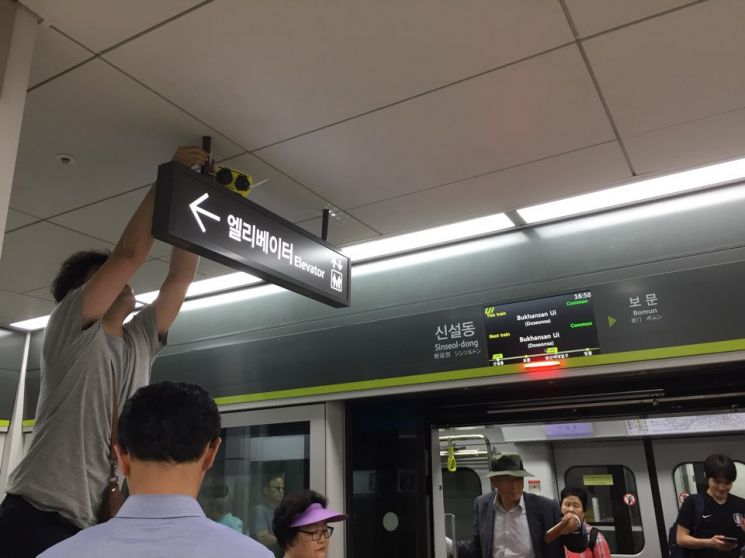
[Asia Economy Reporter Lim Cheol-young] The Seoul Institute of Health and Environment Research announced on the 29th that radon inspections conducted from December last year to April this year at 37 subway stations showed that radon concentrations on platforms and concourses are all safely managed within recommended limits.
The eight stations on Line 9 extension, including Seokchon Station which was most recently opened, maintained an average radon concentration of 32.0 Bq/㎥ over two years from 2018 to 2019, below the recommended limit. Lines 2 to 7 saw a significant decrease in radon levels after the installation of screen doors was completed in 2010. The average radon concentration on Lines 2 to 7 after 2010 was 43.3 Bq/㎥, which is about 44.5% of the average concentration of 97.2 Bq/㎥ recorded between 2007 and 2009 before screen doors were installed.
Additionally, the six key management stations on the Ui-Sinseol Light Rail Transit, opened in 2017, showed a marked decrease in radon concentration to about 25% of the recommended limit since 2019 due to efforts such as improved ventilation facility operations. The average radon concentration at the 13 Ui-Sinseol LRT stations was 119.4 Bq/㎥ in 2017?2018, while the six key management stations recorded an average of 37.8 Bq/㎥ in 2019?2020, showing a decreasing trend.
Shin Yong-seung, director of the Seoul Institute of Health and Environment Research, said, “Since the radon bed incident, public interest in radon management has increased, especially concerns about underground stations located in environments susceptible to rock influence.” He added, “Because radon levels vary greatly depending on temperature and humidity, we will continuously support verifying the effectiveness of reduction devices that reflect ventilation and air circulation principles within stations to ensure radon is safely managed in underground stations.”
© The Asia Business Daily(www.asiae.co.kr). All rights reserved.
![Clutching a Stolen Dior Bag, Saying "I Hate Being Poor but Real"... The Grotesque Con of a "Human Knockoff" [Slate]](https://cwcontent.asiae.co.kr/asiaresize/183/2026021902243444107_1771435474.jpg)
















