KARI Initiates Development of 'Storable Bipropellant Thruster,' a Core Technology for Orbit and Attitude Control
[Asia Economy Reporter Hwang Yoon-joo] Hanwha Corporation is developing a thruster, the "heart of a satellite," in collaboration with the Korea Aerospace Research Institute (KARI). This marks a significant step in domesticating a core technology that has been 100% dependent on foreign sources until now.
Hanwha Corporation announced that it will invest 8 billion KRW by 2025 to jointly develop a "storability bipropellant thruster" with KARI.
The thruster is responsible for orbit adjustment and attitude control of satellites. While Earth's gravity and the gravitational pull of other planets interfere with satellite navigation, the thruster corrects the attitude and is directly linked to the satellite's lifespan, earning it the nickname "the heart of a satellite."
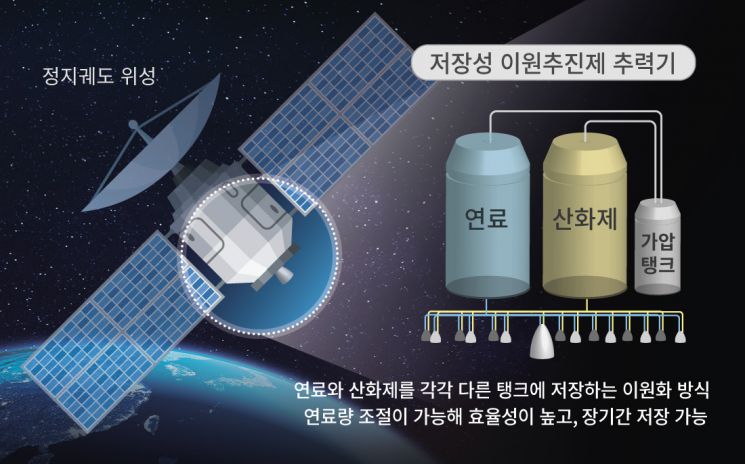
Until now, bipropellant thrusters applied to geostationary satellites have been entirely reliant on products from overseas companies such as those in Germany. The thruster that Hanwha and KARI are developing applies a "storability bipropellant" system that enables geostationary satellites to perform their missions more stably over a longer period. After separation from the launch vehicle, geostationary satellites must ascend to their mission orbit using their own thrusters and operate in extreme space environments for over 15 years. The bipropellant system stores fuel and oxidizer in separate tanks, allowing for fuel quantity control, higher efficiency, and long-term storage of large amounts of fuel.
Kim Seung-mo, CEO of Hanwha Defense Division, stated, "Ahead of the New Space era led by the private sector, domesticating core technologies that were 100% dependent on foreign sources holds great significance."
KARI is conducting the "Space Pioneer" project, an advanced space parts localization initiative led by the Ministry of Science and ICT. This thruster development project is one of the ten tasks starting this year.
Hanwha Corporation has built its technological expertise since the mid-1990s by producing single-propellant thrusters for satellites. The thrusters delivered have been installed on multipurpose practical satellites and next-generation medium satellites and are currently performing missions in space.
© The Asia Business Daily(www.asiae.co.kr). All rights reserved.

















