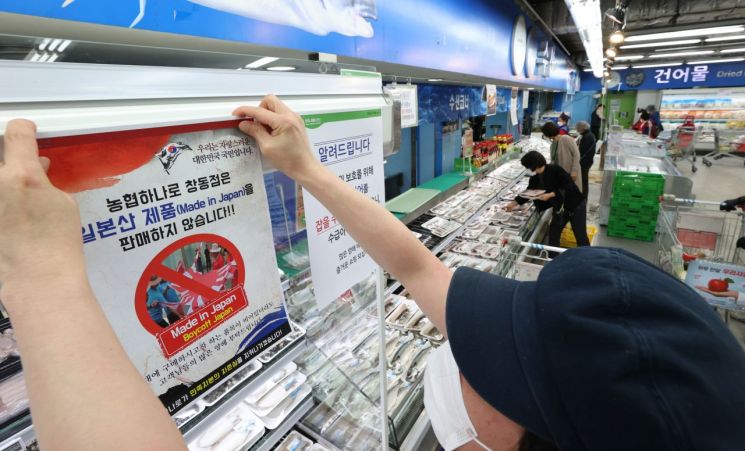
 Last April, an official at the seafood section of Hanaro Mart Changdong Branch in Dobong-gu, Seoul, posted a notice stating that "Japanese seafood products are not sold." [Image source=Yonhap News]
[Asia Economy Reporter Lee Chun-hee] There is a possibility that food produced in the Fukushima region of Japan, where the nuclear power plant accident occurred in 2011, will be supplied to the dining halls of the Tokyo Olympic and Paralympic Village.
On the 27th, the Tokyo Olympic and Paralympic Organizing Committee stated regarding the food to be served at one of the village’s dining halls, 'Casual Dining,' that "ingredients will be sourced from all 47 prefectures."
Prefectures (Todofuken) are Japan’s equivalent to metropolitan and provincial governments, similar to South Korea’s cities and provinces, totaling 47 in number. Since they plan to procure ingredients from all over Japan, food products from Fukushima could also be served at the Olympic and Paralympic tables.
However, the Tokyo Olympic and Paralympic Organizing Committee has stated that it has not yet decided which regions will supply which ingredients.
The Fukushima Prefecture is focusing on using the Tokyo Olympic and Paralympic Games as an opportunity to promote local food products. A Fukushima official explained, "We are preparing dozens of items mainly produced in midsummer," and said that peaches, tomatoes, cucumbers, and other items have been submitted to the organizing committee as possible offerings.
Casual Dining, one of the dining halls set up in the Tokyo Olympic and Paralympic Village, is a 280-seat restaurant established with the purpose of "providing an opportunity to experience the taste of Japan." The organizing committee plans to label the origin of ingredients used in the food served at Casual Dining. However, the 'Main Dining Hall,' a 3,000-seat restaurant where about 700 types of dishes from around the world will be served alternately, will not label the origin of ingredients.
© The Asia Business Daily(www.asiae.co.kr). All rights reserved.
![From Hostess to Organ Seller to High Society... The Grotesque Scam of a "Human Counterfeit" Shaking the Korean Psyche [Slate]](https://cwcontent.asiae.co.kr/asiaresize/183/2026021902243444107_1771435474.jpg)
















