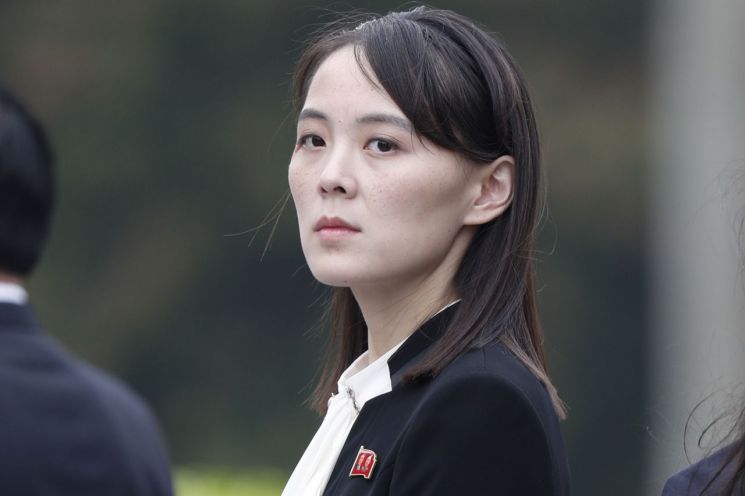
[Asia Economy Reporter Lee Ji-eun] Following Kim Yo-jong, North Korean Vice Department Director, North Korean Foreign Minister Ri Son-gwon also sent a message rejecting contact with the United States, indicating that North Korea-US dialogue is likely to remain stalled for the time being. As both sides shift the responsibility for dialogue onto each other, there is speculation that the upcoming South Korea-US joint military exercises scheduled for August could become a turning point.
On the 25th, at the '7th Korean Peninsula Peace Symposium' held at Lotte Hotel in Seoul, Lee In-young, Minister of Unification, stated, "Despite the statements from Vice Director Kim and Foreign Minister Ri, it is still too early to make definitive judgments, but I believe the overall trend is slowly changing," emphasizing that the North is presenting a new strategy and policy that goes beyond the 'strength against strength, pressure against pressure' approach.
Earlier, Vice Director Kim issued a statement toward the U.S. calling it "interpretation rather than reality," warning that "unrealistic expectations will only lead to greater disappointment." Foreign Minister Ri welcomed Kim’s statement and declared, "We are not considering any meaningless contact or possibilities with the U.S.," effectively pouring cold water on the dialogue momentum created through the end of the South Korea-US working group and the visit of Sung Kim, the U.S. Special Representative for North Korea.
However, experts point out that these statements do not signify an end to dialogue. Since North Korea has not yet established a justification to engage in talks, it is pressuring the U.S. and South Korea to create dialogue momentum.
A key potential breakthrough for dialogue is the termination or reduction of the South Korea-US joint military exercises. On the morning of the 24th, Jeong Se-hyun, Senior Vice Chairman of the National Unification Advisory Council, said on TBS’s 'Kim Eo-jun’s News Factory,' "In colloquial terms, they are playing 'mil-dang' (push and pull)," adding, "If we coordinate more closely and quickly with the U.S. regarding the joint exercises and even leak that the issue is progressing positively and consultations are underway, it would make a difference."
Considering the recent close ties between North Korea and China and the upcoming 100th anniversary of the Chinese Communist Party, the necessity of a four-party talks involving China has also been raised. Jeong Seong-jang, Director of the North Korea Research Center at the Sejong Institute, said, "North Korea currently appears to be pursuing a 'first China, then U.S.' policy, aiming to resume exchanges and cooperation with China first and then consider negotiations with the U.S. if necessary," adding, "Therefore, the U.S. needs to push for a four-party North Korea nuclear talks involving China and South Korea to compel China to bring North Korea to the negotiating table."
© The Asia Business Daily(www.asiae.co.kr). All rights reserved.

















