Bank of Korea 'Overseas Economic Focus'
[Asia Economy Reporter Kim Eunbyeol] China's digital economy is approaching 40% of its total economy, showing a top-level status among emerging countries. This is the result of the Chinese government's active promotion of the transition to a digital economy as a new growth engine to address the gradually weakening growth momentum.
On the 27th, the Bank of Korea stated in its 'Overseas Economic Focus' report that "China's digital economy is rapidly growing, supported by the expansion of related infrastructure centered on mobile, showing a higher digital economy ratio than some advanced countries, thus ranking at the top level among emerging countries." It also reported that the digital economy is driving recent economic growth in China, with online platform and fintech-related companies making significant advances.
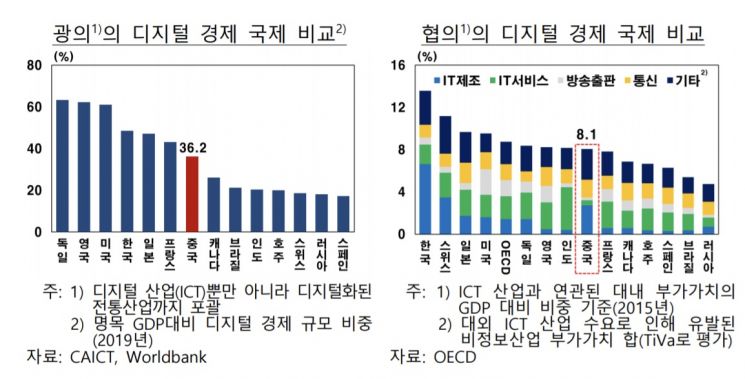
The size of China's digital economy relative to nominal Gross Domestic Product (GDP) was 38.6% last year, nearing 40%. This represents a rapid growth compared to 2005, when the digital economy accounted for only 2.6% of GDP. As digital-related jobs increased, about one-quarter (24.6%) of total employment in 2018 was created within the digital economy.
When comparing the degree of digital transformation with major countries, China showed a higher digital economy ratio than some advanced countries, ranking at the top among emerging countries. In terms of the broad digital economy size, China’s figure was 36.2%, higher than Canada, Brazil, India, Australia, and Switzerland.
A key characteristic of China’s digital economy is that the transition is government-led. The government's digital economy promotion policies, such as the principle of "pilot first, regulate later" and regulations on foreign companies, have greatly contributed to China’s digital transformation. Additionally, China is prominent in the fintech industry, leading the electronic payment sector and being at the forefront of introducing legal digital currency.
Lastly, the Bank of Korea noted that while digital industrialization dominated the early stages of digital transformation, recently, industrial digitalization centered on highly competitive sectors is leading the digital transition.
The Bank of Korea stated, "With increasing investment demand related to new infrastructure and the expansion of the online-based consumer market, the domestic demand base is expected to be strengthened. The fusion of digital technology with labor and capital will enhance productivity, promote competition and innovation, and contribute to expanding medium- to long-term growth potential."
However, it pointed out negative factors such as the potential worsening of employment quality and widening regional disparities during the digital transition process, which could deepen economic imbalances. While strengthening the domestic demand base and improving productivity are expected to positively impact growth potential, concerns remain that economic imbalances may worsen due to deteriorating employment quality and expanding economic gaps between regions.
Furthermore, it was noted that if digitalization progresses slowly due to constraints on innovation capabilities caused by intensified US-China technology disputes and regulations on big tech companies, as well as delays in restructuring some traditional industries, the growth momentum could weaken faster than expected.
© The Asia Business Daily(www.asiae.co.kr). All rights reserved.

















