Integrated management of the entire 1.922 million ㎡ area and focused support projects... Industrial complex management ensuring public interest
Inducing complex development of 13 strategic hubs including underutilized public land and old private factory sites near station areas
[Asia Economy Reporter Lim Cheol-young] The Seoul Metropolitan Government has established an industrial complex plan for G-Valley (Seoul Digital Industrial Complex), covering 1,922,000㎡, and is set to fully implement integrated public management across the entire G-Valley area.
On the 27th, Seoul announced that on the 25th it held the ‘2021 1st Seoul Metropolitan Industrial Complex Planning Deliberation Committee’ meeting and conditionally approved the amendment to the ‘G-Valley National Industrial Complex Plan’ based on this content.
This plan was promoted following the 2009 legal amendment that delegated the authority for development plan changes and implementation plan approvals of the national industrial complex G-Valley to Seoul, and after the Ministry of Land, Infrastructure and Transport first announced the development plan in 2012, Seoul gained practical delegated authority.
This plan is the first national industrial complex plan for G-Valley and is a statutory management plan. It encompasses both development plan changes and implementation plans.
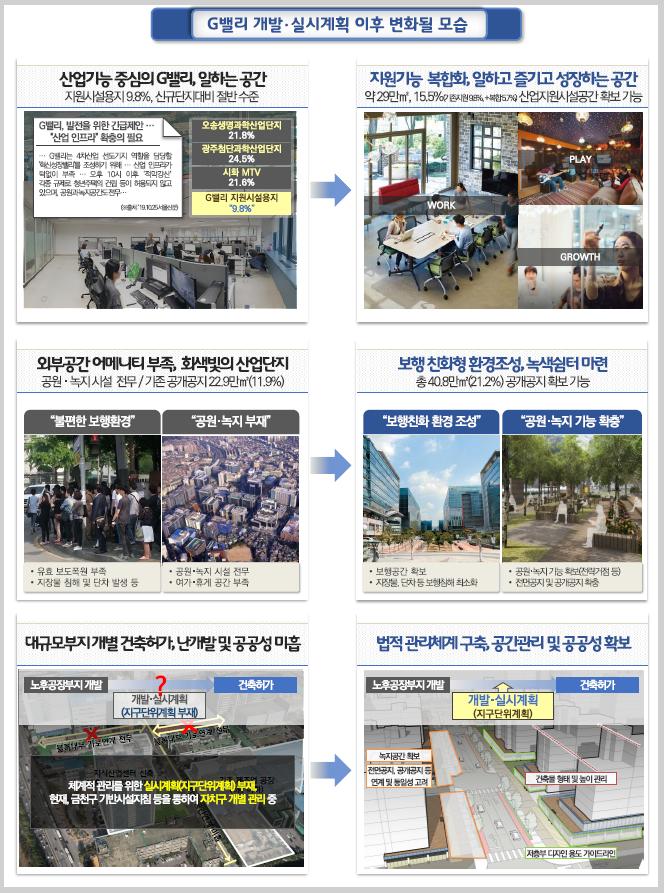
Thirteen strategic hubs, including private factory sites near stations over 30 years old and underutilized public land, were selected to allow for mixed development of industrial facilities as well as commercial and residential facilities. Through public contributions, new industrial exchange spaces and support facilities for companies and workers, which are lacking in G-Valley, will be established, and infrastructure such as green spaces, roads, and pedestrian paths will be expanded to enhance the competitiveness of the industrial complex.
Currently, G-Valley is concentrated with IT manufacturing and software (SW) development and supply industries, and the plan minimizes industry restrictions to enable convergence of various industries such as the 4th industrial revolution, logistics and distribution, culture, and knowledge industries.
The main contents of the amendment include the creation of 13 public and private strategic hubs, the establishment of green and pedestrian-friendly environments, the development of specialized streets, and improvements and expansions of the transportation system and facilities.
To expand support facilities such as corporate exchanges and research and development within G-Valley, 13 strategic hubs have been selected and designated as special planning zones. When establishing detailed development plans, land use changes will be possible to allow industrial and support facilities to coexist on mixed-use land. The 13 strategic hubs consist of low-utilization public land and aged (over 30 years) private factory sites near stations.
When developing strategic hubs, public land must introduce at least 30% of the total floor area as ‘industrial exchange innovation support spaces’ such as R&D centers and startup support facilities. Private land will improve the insufficient support facility infrastructure by expanding industrial innovation support spaces through development profit recovery (50% of land price difference contributed).
Seoul plans to attract central government industrial support projects or promote its own support projects in the secured ‘industrial exchange innovation support spaces.’
Furthermore, to expand green spaces and create pedestrian-friendly environments, street gardens will be established within the front setback lines. In the 13 strategic hubs, park-type public open spaces covering at least 15% of the total site area will be created. Additionally, specialized streets are planned along major street fronts within G-Valley. The main street axes of G-Valley complexes 1, 2, and 3 and station area connection axes will be designated as ‘industrial exchange activation streets’ to diversify low-rise building arrangements and activate land use. The connection axis between G-Valley complex 3’s Gasan Digital Station and Anyangcheon will be designated as a ‘waterfront connection activation street,’ planned to specialize by designating recommended uses such as cafes for street activation and installing arcades.
The floor area ratio plan maintains the current incentive levels applied under the Building Act and other individual laws to ensure fairness with existing developed areas and enhance private sector feasibility, as G-Valley is a completed industrial complex. However, this is premised on securing public interests such as installing pedestrian and vehicle front setbacks to expand internal road capacity, securing at least 15% of the site area as public open space, and installing community facilities for the region and tenant companies.
To facilitate smooth movement of commuting populations and external vehicles, the transportation system will also be supplemented and improved. To reduce congestion within G-Valley, the current 3-4 lane roads will be expanded to 5-7 lanes, and the Doosan-gil underground road project will be promoted to enable smooth communication between complexes 2 and 3, which are separated by the Gyeongbu Line. Bicycle-only roads and pedestrian-priority streets will also be created to improve pedestrian-friendly road environments.
Meanwhile, the conditionally approved amendment will be supplemented regarding the conditions and then the Seoul Mayor will establish and announce the industrial complex plan. In the second half of 2021, detailed development plans for strategic hub development will begin, starting with the Seoul Digital Sports Complex site owned by the Korea Industrial Complex Corporation.
Kim Ui-seung, Director of Seoul’s Economic Policy Office, said, “We improved the previous method where building permits were issued by autonomous districts without systematic implementation plans (district unit plans) for management, by establishing an implementation plan that covers the entire area to build a legal management system, thereby securing spatial management and public interest. Through this industrial complex plan, we have laid the foundation to integrate and continuously supply support projects that were previously pursued individually, and we will focus public support on recreating G-Valley as a smart innovative urban industrial complex.”
© The Asia Business Daily(www.asiae.co.kr). All rights reserved.
![Clutching a Stolen Dior Bag, Saying "I Hate Being Poor but Real"... The Grotesque Con of a "Human Knockoff" [Slate]](https://cwcontent.asiae.co.kr/asiaresize/183/2026021902243444107_1771435474.jpg)
















