Consultation on Economic Policy Direction for the Second Half of the Year
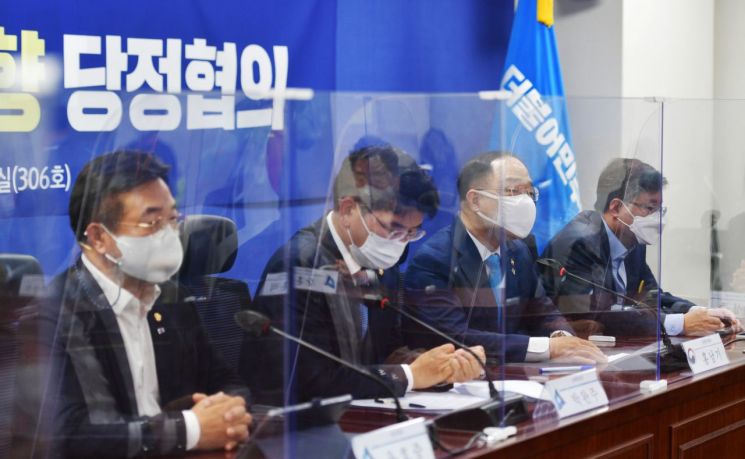
[Sejong=Asia Economy Reporters Kim Hyunjung and Jeon Jinyoung] The ruling party and the government have decided to focus on overcoming the damage caused by COVID-19 and revitalizing the domestic economy by supporting vulnerable groups through the supplementary budget (supplementary budget) to be prepared in the second half of this year. They are also promoting a plan to refund the increased amount of card usage as cashback to stimulate domestic consumption. However, they have not reached a conclusion on the scope of disaster relief payments, which the ruling party and government have been debating continuously, and will continue additional discussions until next week.
On the morning of the 25th, the Democratic Party of Korea and the government held a 'Second Half Economic Policy Direction Party-Government Meeting' at the National Assembly to discuss this plan. After the meeting, Park Wanju, chairman of the Policy Committee, said in a briefing, "We will prioritize preparing support measures to overcome the damage caused by COVID-19 and to recover the domestic economy through the supplementary budget." This supplementary budget includes support for vulnerable groups such as small business owners and self-employed individuals. The ruling party and government decided to promote a 'National Consumption Encouragement Fund' that refunds the increased amount of individual card usage as cashback so that both merchants and consumers can coexist. The cashback limit will be determined through additional discussions between the ruling party and government. The government proposed a limit of 300,000 won. In addition, efforts to stabilize employment, such as expanding the supply of management fund loans for small business owners and extending the payment period of employment retention subsidies, will also be made.
The ruling party and government will continue discussions on the scope of disaster relief payments, on which they have not reached an agreement. The Democratic Party advocates for payments to all citizens, while the government insists on the 'bottom 70% income group,' but it is expected that an agreement will be reached at around 80-90%. In addition, the ruling party and government will work on measures to support tax incentives for system semiconductors, bio-health, and future car sectors, accelerate the promotion of the Korean New Deal, overcome low birth rates, and solve youth asset formation issues.
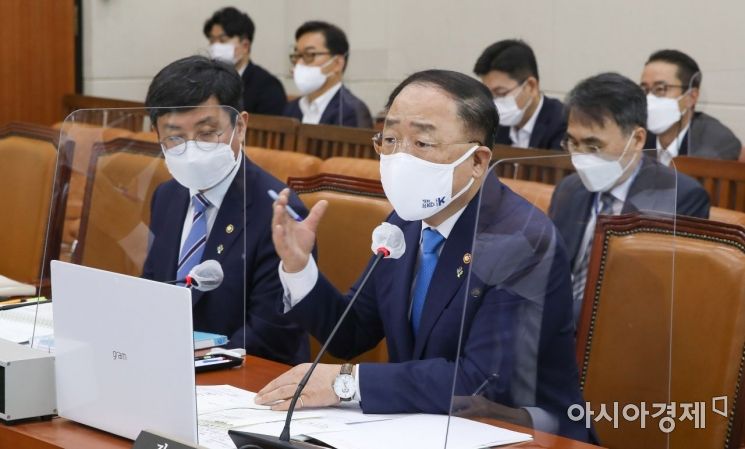 Deputy Prime Minister for Economic Affairs Hong Nam-ki is attending the plenary meeting of the Planning and Finance Committee held at the National Assembly on the 25th, responding to members' questions. Photo by Yoon Dong-joo doso7@
Hong Nam-ki, Deputy Prime Minister and Minister of Economy and Finance, reiterated his opposition to nationwide disaster relief payments at the full meeting of the Planning and Finance Committee on the same day. Responding to ruling party lawmakers criticizing the government's opposition to nationwide disaster relief payments, Minister Hong said, "Last year, the government conducted four supplementary budgets in 59 years and is pushing for a second supplementary budget this year, and I believe the government has done its role to the maximum extent possible," adding, "As the minister in charge of finance, I do not hoard the treasury but have been given a mission by the people to use taxes rationally and efficiently."
© The Asia Business Daily(www.asiae.co.kr). All rights reserved.
![Clutching a Stolen Dior Bag, Saying "I Hate Being Poor but Real"... The Grotesque Con of a "Human Knockoff" [Slate]](https://cwcontent.asiae.co.kr/asiaresize/183/2026021902243444107_1771435474.jpg)

















