Bank of Korea, Korea Economic Research Institute Business Survey Index (BSI) Survey
"Exports Are Stable but Uncertainty Remains... Delta Variant Also a Factor"
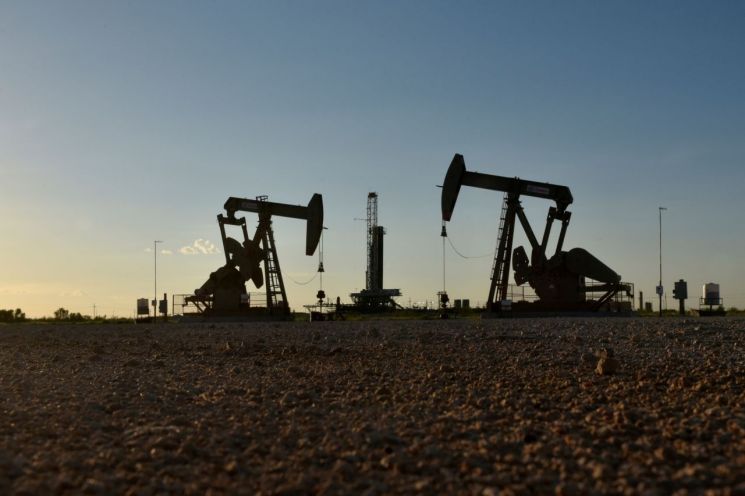
[Asia Economy Reporters Eunbyeol Kim and Hyunjin Jeong] Recently, as raw material prices including oil have soared, the perceived business conditions of domestic companies have shown signs of stagnation. While exports continue to perform well, centered on front industries such as semiconductors and electronic components, petrochemical companies have experienced a freeze in their business sentiment due to increased cost burdens as international oil prices surpassed $70 per barrel.
According to the 'June 2021 Business Survey Index (BSI) and Economic Sentiment Index (ESI)' released by the Bank of Korea on the 25th, the overall industry business condition BSI recorded 88 this month, remaining flat for the third consecutive month. The overall industry business condition index, which had shown a clear improvement trend since the beginning of this year, rose to 88 in April, marking the highest point since May 2011 (90), but no further improvement has been observed. The BSI is a statistic that surveys business owners' judgments and outlooks on current business conditions; if negative responses outnumber positive ones, the index falls below 100.
Among these, the manufacturing industry business condition BSI rose 2 points from the previous month to 98, showing the highest level in 10 years and 2 months since April 2011 (99). Improvements were centered on electrical equipment (+6 points) and electronic, video, and communication equipment (+3 points) due to increased demand for cables, semiconductors, and electronic components. However, the chemical substances and products sector (-5 points) saw a decline in business sentiment due to a reduced spread between product prices and raw material costs. Within manufacturing, the large enterprises with a high proportion of chemical companies recorded a 3-point drop in business outlook BSI to 107, while small and medium enterprises (88) rose by 8 points. The non-manufacturing business condition BSI also remained at 81, the same level as the previous month. The wholesale and retail sector (-7 points) fell sharply due to rising costs of goods sold and supply disruptions, and the real estate sector (-6 points) struggled due to decreased income from sales and rentals.
Kim Daejin, head of the Corporate Statistics Team at the Bank of Korea's Economic Statistics Bureau, explained, "While some semiconductor supply issues in manufacturing have been somewhat resolved, the sentiment in non-manufacturing has not improved due to rising raw material prices and logistics problems." He added, "Exports are improving, so the possibility of better business sentiment going forward remains high," but also noted, "Uncertainty remains high due to factors such as rising raw material prices and the COVID-19 Delta variant."
In the BSI survey conducted by the Korea Economic Research Institute targeting the top 600 companies by sales, the July outlook (102.3) fell compared to the previous month. This is due to expectations that supply difficulties for major raw materials and semiconductor parts will prolong. Companies fearing a decrease in demand are unable to fully pass on cost increases to selling prices, which also worsens profitability. Investment (102.3) and employment (105.7) showed predominantly positive outlooks, but domestic demand (100.0) has steadily weakened since March, and profitability (99.7) continued to show a negative outlook following June.
By sector, manufacturing decreased by 4.2 points to 100.9 compared to the previous month, marking a decline for four consecutive months since March (114.0). The non-manufacturing outlook rose by 5.0 points to 104.4 from the previous month (99.4), turning positive. Choo Kwangho, head of the Economic Policy Office at the Korea Economic Research Institute, said, "Uncertainty in the manufacturing economy can soon act as a downside factor for the entire real economy," and added, "Government-level measures are required to overcome supply disruptions of raw materials and parts."
© The Asia Business Daily(www.asiae.co.kr). All rights reserved.
![Clutching a Stolen Dior Bag, Saying "I Hate Being Poor but Real"... The Grotesque Con of a "Human Knockoff" [Slate]](https://cwcontent.asiae.co.kr/asiaresize/183/2026021902243444107_1771435474.jpg)
















