Lee Nak-yeon and Jeong Sye-gyun factions likely to discuss and issue a statement
"Violation of party rules... Party Affairs Committee must be convened," intense reactions also reported
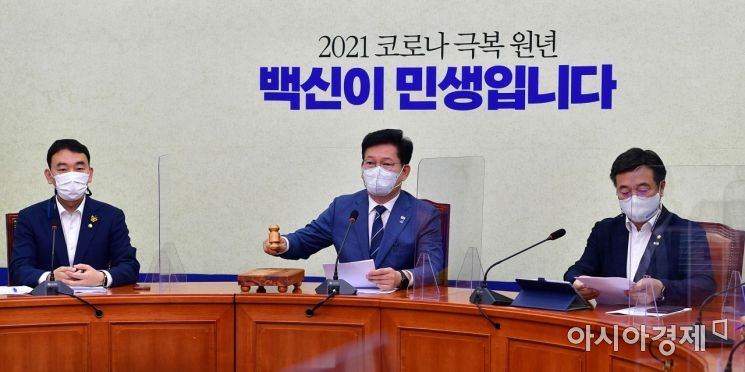 Song Young-gil, leader of the Democratic Party of Korea, is attending and presiding over the Supreme Council meeting held at the National Assembly on the 25th. Photo by Yoon Dong-joo doso7@
[Asia Economy Reporters Park Cheol-eung and Oh Ju-yeon] The Democratic Party of Korea will proceed with the presidential primary schedule as originally stipulated in the party constitution without postponement. Accordingly, the Democratic Party will hold a preliminary primary (cutoff) next month in July and select its presidential candidate between September 5 and 10.
On the 25th, the Democratic Party’s Supreme Council resolved to maintain the party constitution’s rule of selecting the presidential candidate 180 days before the election. Song Young-gil, leader of the Democratic Party, stated, "Under the consensus that the leadership must move forward as one, even Supreme Council members with differing opinions agreed and united their efforts to make this decision."
After the meeting, Go Yong-jin, the Democratic Party’s chief spokesperson, told reporters, "There were Supreme Council members advocating for postponement, but everyone agreed that the decision could no longer be delayed, and it was finalized by the Supreme Council vote." He added, "To change the schedule of 180 days before the election, a Party Affairs Committee meeting is required, but if we proceed as currently planned, the Supreme Council’s decision is sufficient." Go initially used the term "unanimous," but quickly corrected himself, saying, "It would be better to clarify the terminology. Let’s say it was decided by the Supreme Council vote," apparently considering dissenting opinions within the Supreme Council.
Those advocating for postponing the primary immediately voiced opposition and began preparing countermeasures. They regard the current leadership’s decision as ineffective under party constitution and regulations and are preparing to hold a separate Party Affairs Committee meeting for discussion. Park Kwang-on, a key figure in the Lee Nak-yeon faction, told Asia Economy in a phone interview, "It seems difficult to agree that the party has sufficiently reflected the opinions sincerely submitted by the lawmakers," adding, "We will discuss countermeasures including convening the Party Affairs Committee and announce our position within today." The Jeong Se-gyun camp also said it would release a statement after internal discussions.
The faction advocating postponement views the Party Affairs Committee as a mandatory step. A senior lawmaker criticized, "Saying that the Party Affairs Committee is not necessary violates the party constitution and regulations." Jeon Hye-sook, a Supreme Council member who has strongly pushed for postponement, said, "My position that the primary should be postponed due to COVID-19 prevention remains unchanged," and lamented, "Isn’t democracy fundamentally about the principle of majority rule? I am feeling very distressed right now."
It is reported that those advocating postponement have already circulated a petition among Party Affairs Committee members to meet the requirement of ‘one-third of the total members’ needed to convene a meeting. Depending on the discussions within each camp, a request to convene the Party Affairs Committee may be submitted to the party. Park said, "If Party Affairs Committee members request a meeting, it must be held. Of course, there may be opinions favoring a grand compromise, but we cannot avoid considering convening the Party Affairs Committee. Whether the party leader will bring the postponement agenda to the Party Affairs Committee could become another point of controversy."
Leader Song has emphasized that the authority to decide the primary schedule rests with him, but the opposing side insists that without going through the Party Affairs Committee as stipulated in the party constitution and regulations, the decision is invalid. If the party leader refuses to convene the Party Affairs Committee, the floor leader or elected Supreme Council members in order of vote share can convene it. The mere submission of a request to convene the Party Affairs Committee signals a power struggle within the party, which could lead to division within the Democratic Party and severely shake Leader Song’s leadership.
© The Asia Business Daily(www.asiae.co.kr). All rights reserved.

















